The problem
A diver of mass drops from rest from a platform above the water surface. Once in the pool, he comes to a stop at a depth .
- What is his velocity (magnitude, direction and sense) when he reaches the water?
- What is the average force exerted on him by the water while he slows down?
Exercise taken from U. Amaldi, Dalla mela di Newton al bosone di Higgs, vol. 2 — Multimediale, Zanichelli, p. 362, no. 10 [5].
Conventions
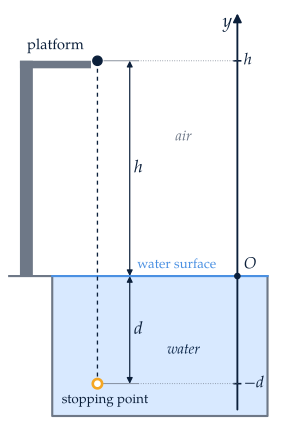
- Axis and origin. A single vertical axis , pointing upwards, with origin at the water surface (Figure 1). Every vector quantity pointing up has a positive component, pointing down a negative one. Since the motion is one-dimensional, we only write components along : for instance the weight is and we denote it by its component . (We write the weight as because the letter is reserved for work.)
- Two stopwatches. In the air phase the time starts from zero when the diver leaves the platform; in the water phase it restarts from zero when he touches the water.
- Potential energy. The zero of gravitational potential energy is at the water surface: , so above the water and below it.
- Assumptions. The diver is treated as a point mass; air resistance is negligible (we will justify this at the end); the force of the water is constant.
- Data. , , , .
The strategy in brief
The motion splits into two phases, each with constant forces and therefore constant acceleration. We solve it first with kinematics and dynamics, then with energy.
- Section 1 — In the air. The only force is the weight: the motion is uniformly accelerated with acceleration , which gives the time of flight and the entry velocity.
- Section 2 — In the water. The forces are the weight and the force of the water, assumed constant: the motion is uniformly decelerated and brings the velocity to zero over a distance . From the deceleration, Newton's second law gives the force.
- Section 3 — Another route: the energy balance. Comparing the mechanical energy at the start and at the end gives the same results in a few lines, without accelerations or times.
- Section 4 — What the formula tells us. How the result depends on the parameters.
We solve everything in symbols and plug in the numbers only at the end, so that the final formulas show which quantities each result depends on, and can be discussed as the data change.
1. The fall through the air
Where we are. The diver starts from rest at height .
Goal. Find the time of flight and the velocity with which he hits the water.
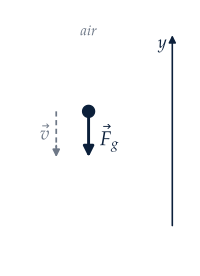
Idea. Neglecting the air, the only force is the weight (Figure 2). Close to the Earth's surface the weight is constant, so by Newton's second law the acceleration is constant too: . The motion is uniformly accelerated.
- Position as a function of time. With , and :
- Time of flight. The diver reaches the water when :
(the negative root, which comes before the start, is discarded).
- Entry velocity. From the velocity law , substituting (1):
The minus sign says that the velocity points down, as it must.
- Numbers.
The diver enters the water at about downwards, that is about .
Check.
- Units of (1). . ✓
- Units of (2). . ✓
- Average speed, for (1) and (2). In uniformly accelerated motion from rest the average speed is half the final speed. Indeed , which is exactly . ✓
Let's recap
In the air the motion is uniformly accelerated. The diver falls for and enters the water with , that is about downwards. The result does not depend on the mass.
2. Slowing down in the water
Where we are. The diver enters the water at with velocity and stops at .
Goal. Find the deceleration, the average force of the water and the stopping time .
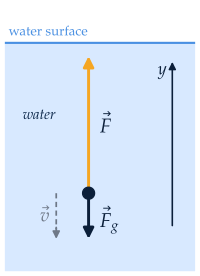
Idea. In the water two forces act on the diver (Figure 3): the weight, with component , and the force of the water, with component (upwards, because it slows him down). Both are constant, so the acceleration is constant too: the motion is uniformly decelerated. Since we know the stopping distance but not the time, it is convenient to use the relation between velocity and displacement, which does not contain .
- Deceleration. In uniformly accelerated motion1
Here , , and the diver stops () at :
Using (2), , we get
The acceleration is positive, that is upwards: exactly what slows down a body moving down.
- Force of the water. Newton's second law along the axis gives
Substituting (3):
Watch out — Don't forget the weight
A common mistake is to write , that is, to mistake the net force on the diver for the force exerted by the water. This would give . In the water, however, the weight still acts downwards: the water has both to slow the diver down and to hold him up, so . The data themselves show that is wrong: with a water force of the net force would be only , the diver would decelerate at and would stop at a depth of , not . This is the mistake found in the answers of the book the exercise is taken from [5], which give .
- Stopping time. From the velocity law , setting :
Since , this simplifies to
that is, the time needed to cover at the average speed , as in any uniformly decelerated motion down to rest.
- Numbers. With :
The data have two significant figures, so the result should be rounded to , pointing up: three times the diver's weight.
Check.
- Units of (4). is dimensionless and is a force. ✓
- A limiting case for (4). If the diver enters the water at rest and there is nothing to stop; (4) gives , so the water only has to balance the weight. ✓
- Impulse, for (4) and (5). While slowing down, the momentum goes from to zero, so the impulse of the net force must equal . Numerically: , and . The two values agree. ✓
Let's recap
In the water the diver decelerates with and stops in . The average force of the water is upwards, three times the weight.
3. Another route: the energy balance
Where we are. We have solved the problem with kinematics: accelerations, equations of motion, times. But the questions only ask for a velocity and a force, and the data are heights and distances, not times.
Goal. Recover (2) and (4) by comparing the diver's energy at a few key positions, without computing accelerations or times.
Idea. When the data are positions and the unknowns are velocities or forces, an energy balance is the natural tool. In the air only the weight acts, and it is a conservative force: mechanical energy is conserved. In the water the force of the water also acts, and it is not conservative: mechanical energy decreases, and the decrease equals the (negative) work done by the water on the diver (Memento M1).
Memento M1 — Mechanical energy and non-conservative forces
The mechanical energy of a body is the sum of its kinetic and potential energy:
- If work is done on the body only by conservative forces (such as the weight), mechanical energy is conserved: .
- If non-conservative forces (friction, drag) also do work, the change in mechanical energy equals their work:
This says the same as the work–energy theorem, , with the work of the weight moved to the left-hand side as potential energy.
The work of a constant force with component along a displacement on the axis is : positive if force and displacement point the same way, negative if they point opposite ways.
The energies at the three positions are:
| Position | Height | |||
|---|---|---|---|---|
| — platform | ||||
| — water surface | ||||
| — stopping point |
- From to : the entry velocity. In the air only the weight acts, so :
Energy gives the magnitude of the velocity; its sense, downwards, is known from the problem. We thus recover (2), , in one line.
- From to : the force of the water. In the water the force of the water, with component upwards, does work along the displacement , downwards. Force and displacement point opposite ways, so the work is negative:
By Memento M1, :
where the last step uses Step 1. Dividing by we recover (4):
- From to in one go. The entry velocity is actually not needed to find the force. In the balance between the platform and the stopping point the diver is at rest both at the start and at the end, and the only non-conservative force is that of the water, which acts only over the last metres:
which is (4) again, obtained in two lines and without the entry velocity.
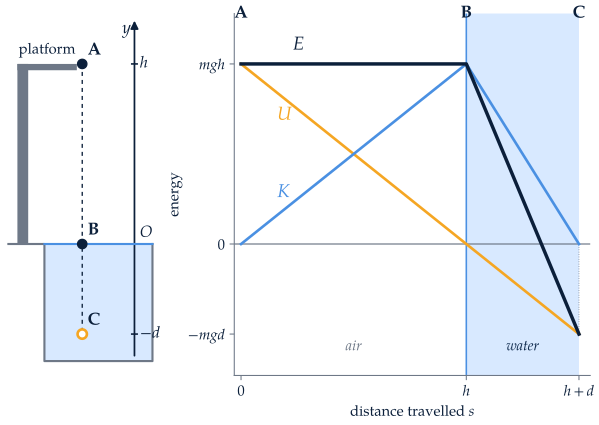
Remark — The slopes are forces. In Figure 5 the energies are plotted against the distance travelled , measured from the platform downwards. They are all straight lines, because the forces are constant: over a stretch each constant force does work equal to its component along the motion times , and by the work–energy theorem is the work of the net force. The slopes of the lines are therefore forces:
- has slope everywhere: minus the component of the weight along the motion;
- has slope in the air (only the weight acts) and in the water, that is in our case: this is why in the water falls twice as steeply as it rose;
- has slope zero in the air and in the water, that is in our case: the work of the force of the water per metre travelled.
Check.
- Comparison with Section 1. Step 1 gives , the same magnitude as (2). ✓
- Comparison with Section 2. Step 2 and (6) give , the same expression as (4). Numerically, , as before. ✓
- Units of (6). On the left a force times a length, on the right a weight times a length: both sides are work, in joules. ✓
Watch out — In the water mechanical energy is not conserved
A common mistake is to write , that is "energy is conserved", for the whole path: this would give , which is absurd. In the water a non-conservative force acts, and the diver's mechanical energy decreases by , about . That energy does not vanish: it goes to the water, which is set in motion (splashes, waves, eddies) and in the end warms up imperceptibly. That is negative, on the other hand, should come as no surprise: it follows from putting the zero of potential energy at the water surface. With a different zero all the values would shift by the same constant, but the decrease would stay the same.
Let's recap
The energy balance leads to the same results as kinematics in a few lines. In the air mechanical energy is conserved and gives . In the water it decreases by an amount equal to the work of the force of the water; between the platform and the stopping point the balance is .
Which route to choose? Energy is the faster route when the data are heights and distances and the unknowns are velocities or forces. It does not give times, though: for and you need the equations of motion of Sections 1 and 2 or, for , the impulse.
4. What the formula tells us
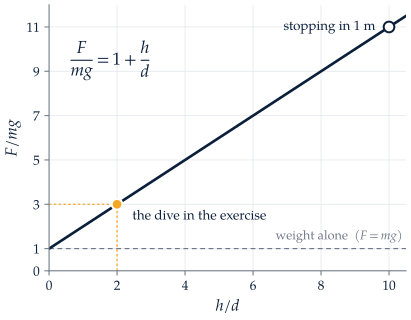
Formula (4) can be written as the ratio between the force of the water and the weight:
- It depends neither on the mass nor on . A heavier diver feels a larger force, but always the same multiple of his own weight. On the Moon the force would be smaller in newtons, but the ratio would stay the same.
- Only the ratio matters. Doubling both the height and the stopping distance leaves the ratio unchanged. The graph is a straight line of slope starting from (Figure 4).
- The energy reading. Formula (6) says that in just metres the water has to dissipate the potential energy lost over the whole drop . That is why : the shorter the stopping distance compared with the drop, the stronger the force.
- Stopping in a short distance is costly. If decreases for a given , the term grows quickly: stopping in instead of would mean feeling instead of . This is why diving pools must be deep.
- If the stopping distance is very large (), the force tends to the weight: the water does little more than support the diver.
Watch out — What "average force" means
The real force of the water is not constant: it is large at impact, when the speed is high, and decreases as the diver slows down. The we computed is the equivalent constant force that has the same effect, that is, stops the diver over the same distance : it does the same work as the real force, so it is its average over distance. This is exactly what (6) says.
The average over time (impulse divided by the stopping time) is in general a different quantity, and it coincides with ours only if the force really is constant, as we assumed. Comparing them would require knowing how the force varies while the diver slows down, which the problem does not say.
Moreover, stands for the whole action of the water: Archimedes' buoyancy and the resistance to motion together. The exercise does not separate them, and there is no need to do so to answer the question.
Order of magnitude — What about air resistance?
At the start we neglected the air. Let us see how good this approximation is in the worst case.
The data. According to the FAI (Fédération Aéronautique Internationale), a human body in a stable belly-to-earth free fall reaches a terminal velocity of about , that is ; head-down, the terminal velocity rises to about – [1]. The belly-to-earth position is the one with the most drag, so it is the worst case for us.
The model. At the speeds involved, air drag grows with the square of the speed: . At terminal velocity the drag balances the weight, , so and
The estimate. At water entry, the highest speed of the whole fall, : the drag is at most 6% of the weight, and only at the very last instant.
The effect on the result. Solving the motion with quadratic drag (a differential equation beyond the high-school syllabus) gives the entry velocity
where the exponent is dimensionless. With this gives instead of : less than 2% lower, and the force of the water would drop by about 2%. A real diver enters the water streamlined, with less drag: with the head-down terminal velocities the effect falls to about 1%.
Conclusion. For a dive, neglecting the air is an excellent approximation. It would not be for a skydiver, who actually reaches terminal velocity.
Historical note — Galileo and falling bodies
The law of fall used in Section 1 goes back to Galileo Galilei. In the Discourses and Mathematical Demonstrations Relating to Two New Sciences (Leiden, 1638), Third Day, Theorem II (Proposition II) states that the distances covered by a body starting from rest in uniformly accelerated motion are to each other as the squares of the times taken [2]. This is our expressed as a proportion, since Galileo did not yet write equations. On the same Day he describes his experiments with balls rolling down an inclined plane, which he used to slow the fall down enough to measure it.
More famous, but less certain, is the experiment from the Leaning Tower of Pisa. It is told by Vincenzo Viviani, Galileo's pupil, in his Racconto istorico della vita di Galileo (1654): from the top of the bell tower Galileo is said to have shown that bodies of the same material but different weights fall with the same speed, against Aristotle's view. The Museo Galileo in Florence notes that the historical truth of this episode is doubtful [3].
Fun fact — Springboard or platform?
A springboard is a flexible board that gives the diver a push; at there is no springboard but a rigid platform. The platform is set out in the diving-facility rules of the international federation of aquatic sports (now World Aquatics, formerly FINA) [4].
Let's recap — The full picture
| Quantity | Formula | Value |
|---|---|---|
| Time of flight | (1) | |
| Entry velocity | (2) | downwards |
| Deceleration in the water | (3) | upwards |
| Average force of the water | (4), (6) | upwards, |
| Stopping time | (5) |
- The problem splits into two uniformly accelerated motions, one in the air and one in the water, linked by the entry velocity.
- With an oriented axis the signs take care of themselves: downward velocities are negative, braking accelerations and forces are positive.
- When the distance is known but the time is not, in kinematics use .
- The energy balance reaches the same results faster: mechanical energy is conserved in the air and decreases in the water by the work of the force of the water. It does not give times, though.
- The symbolic result says more than the numbers: only the ratio between the height of the fall and the stopping distance matters.
Bibliography
- [1]FAI — Fédération Aéronautique Internationale, ISC Skydiving Commission, Speed Skydiving. https://fai.org/node/24646 (accessed 24 October 2026).
- [2]G. Galilei, Discorsi e dimostrazioni matematiche intorno a due nuove scienze, Leiden, Elsevier, 1638, Third Day, Theorem II, Proposition II. Online text with parallel English translation: Museo Galileo (formerly Istituto e Museo di Storia della Scienza), https://imss.fi.it/ms72/DHTML/D202.HTM.
- [3]Museo Galileo, Scientific Itineraries in Tuscany — Leaning Tower. https://brunelleschi.imss.fi.it/itineraries/place/TorrePendente.html. The account is in V. Viviani, Racconto istorico della vita di Galileo (1654).
- [4]FINA (now World Aquatics), Diving Facilities Certificate Guide, February 2020, rules FR 5. https://resources.fina.org/fina/document/2023/04/18/f480c3c0-71c0-48a1-a031-5198218c7607/fina_diving_facilities_certificate_guide_february_2020_0.pdf
- [5]U. Amaldi, Dalla mela di Newton al bosone di Higgs, vol. 2 — Multimediale (Cinematica, Dinamica, Termologia), Zanichelli. ISBN 978-88-08-23636-4. Exercise 10, p. 362 (answer on p. 363). Online resources for the book: https://online.zanichelli.it/amaldimela.
Revised version of an article published on keenonmaths.org in April 2020.