Where it comes from
This piece grew out of an interesting exchange with a fourth-year student at an Italian liceo scientifico (science-oriented high school), with whom I worked through a problem on the Carnot engine from his textbook: a short exercise, two questions, few calculations.
Precisely because the calculations are few, the problem is a chance to stop and think about a few fundamental concepts, which then turn out to be the key to solving it. During the solution the student asked several times why a step worked, and each question led us to clarify a point that the problem leaves implicit: what the first law of thermodynamics really says, why in an isothermal process the heat exchanged equals the work, and more.
Here those points are not buried in the calculations: each has its own space, in the Memento and Watch out boxes, so that the solution also answers the questions a problem like this one raises.
The problem
A heat engine runs on Carnot cycles, with an efficiency of 32.0% and a frequency of 10.0 Hz. During the isothermal compression, 630 J of work is done on the gas.
- a) Find the heat the gas absorbs from the hot reservoir.
- b) Find the change in the internal energy of the gas 10.0 s after the engine is started.
Problem 40 on p. 820 of U. Amaldi, Dalla mela di Newton al bosone di Higgs, vol. 3 — Multimediale, Zanichelli, Bologna, 2015 [1]; reworded with the same data.
| Quantity | Symbol | Value |
|---|---|---|
| Efficiency | ||
| Frequency (cycles per second) | ||
| Work done on the gas in the isothermal compression | ||
| Running time | ||
| Heat absorbed from the hot reservoir | ? | |
| Change in internal energy after | ? |
Conventions
- Cycle , as in the textbook: isothermal expansion at temperature , adiabatic expansion, isothermal compression at temperature , adiabatic compression.
- is the temperature of the hot reservoir, that of the cold reservoir (so ).
- is the heat absorbed from the hot reservoir, the heat released to the cold reservoir. Throughout this solution and are absolute values, i.e. positive quantities; who absorbs and who releases is stated in words. The textbook, instead, gives heats a sign: and . Where the textbook has , here we have its absolute value.
- In the first law , is the heat absorbed by the gas and the work done by the gas, both with their sign. In a compression, work is done on the gas, so .
The strategy in brief
- Section 1 — Heat absorbed. In a Carnot cycle the gas exchanges heat only during the two isotherms. In the isothermal compression the internal energy does not change, so the heat released equals the work done on the gas: this gives . The efficiency then links to .
- Section 2 — Internal energy. Internal energy is a state function: after each complete cycle the gas is back in its initial state. In the engine performs a whole number of cycles, so .
1. Heat absorbed from the hot reservoir
Where we are. We know the efficiency and the work done on the gas in the isothermal compression . We know neither the reservoir temperatures nor the number of moles of gas.
Goal. Find , the heat absorbed from the hot reservoir in one cycle.
Idea. The efficiency links to ; in turn, follows from the work of stage , because the internal energy of an ideal gas does not change along an isotherm.
Memento M1 — The Carnot cycle
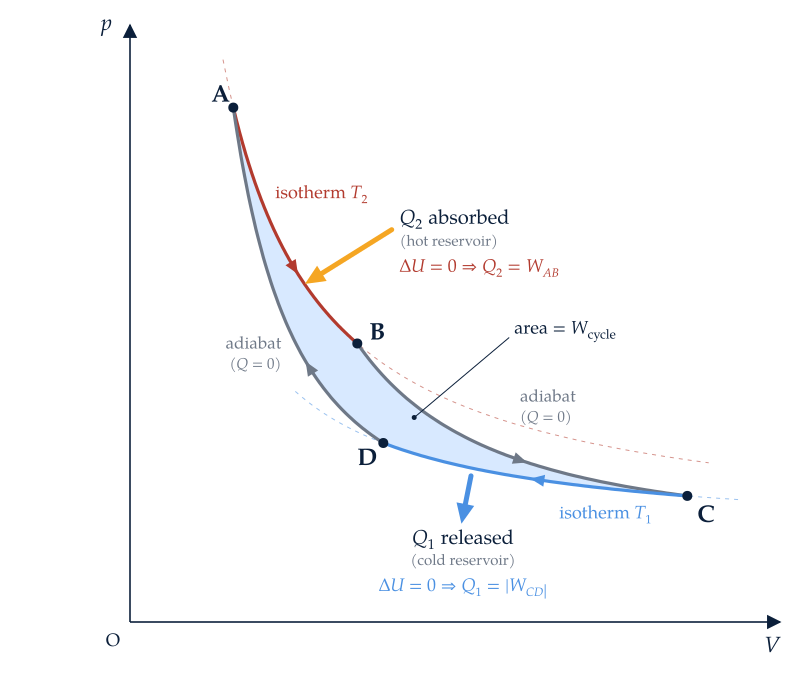
The Carnot cycle consists of four reversible processes of an ideal gas, between two reservoirs at temperatures :
- — isothermal expansion at : the gas absorbs the heat from the hot reservoir;
- — adiabatic expansion: no heat exchanged, the temperature drops from to ;
- — isothermal compression at : the gas releases the heat to the cold reservoir;
- — adiabatic compression: no heat exchanged, the temperature rises back to .
The gas exchanges heat only during the two isotherms: all of enters along , all of leaves along (Figure 1).
Memento M2 — The first law of thermodynamics
The first law is conservation of energy applied to a thermodynamic system, such as the gas in our engine. If the gas absorbs the heat and does the work , its internal energy changes by
In words: the internal energy of the gas increases by the heat that flows in and decreases by the work the gas does on its surroundings. With the conventions adopted here, if the gas absorbs heat and if it releases it; if the gas does work (expansion) and if work is done on it (compression).
Memento M3 — Internal energy of an ideal gas
The internal energy of an ideal gas depends only on temperature. In an isothermal process, therefore, and the first law (Memento M2) becomes
Along an isotherm, heat and work have the same value and the same sign: in an expansion the gas does work () and absorbs heat (); in a compression work is done on it () and it releases heat ().
Memento M4 — Efficiency of a heat engine
The efficiency is the ratio of the work produced in one cycle to the heat absorbed from the hot reservoir. Over a complete cycle the gas returns to its initial state, so and, by the first law (Memento M2), the net work is the difference between heat absorbed and heat released, (Figure 2). With absolute values:
For a Carnot cycle we also have ; we do not need it here, because the efficiency is given directly.
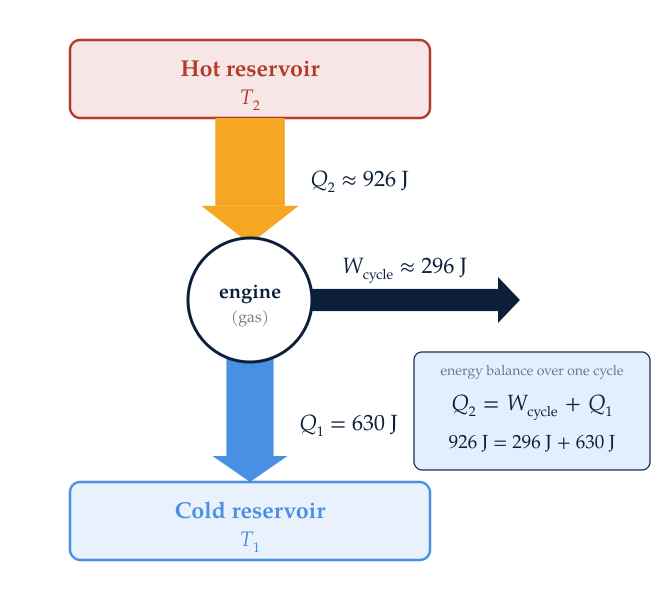
- Heat released to the cold reservoir. We apply Memento M3 to the isothermal compression . The text says that of work is done on the gas, so the work done by the gas is . Since :
The minus sign tells us the gas releases heat. In absolute value, all the work done on the gas leaves as heat towards the cold reservoir (Memento M1: all of leaves along ):
- Heat absorbed, from the efficiency formula. From Memento M4, . We solve for and substitute (1):
- Net work per cycle. We will need it for the check and for Section 2. From Memento M4 and (2):
- Discussion in terms of the efficiency. Formulas (2) and (3) hold for any efficiency . For a fixed compression work :
- the factor is always greater than 1, so : the engine always absorbs more heat than it releases, and the difference is the work produced;
- as , and : the engine just "passes" heat from the hot to the cold reservoir without producing work;
- as grows, grows without bound: as the ratio would have to go to zero, i.e. the engine would turn almost all the absorbed heat into work. The second law of thermodynamics forbids this: for a Carnot cycle it would require , a cold reservoir at absolute zero.
- The numbers. The efficiency goes in decimal form: . From (2):
From (3):
The results have three significant figures, like the data ( and ).
Watch out — is not the work of the cycle
A common mistake is to plug into the definition of efficiency as if it were the work of the whole cycle: . This is wrong: is the work of the isothermal compression alone. The net work of the cycle is a different quantity, given by (3).
Check.
- Formula (3) and the definition of efficiency (Memento M4). : we recover the efficiency. ✓
- Formula (2), dimensions. The numerator is a work (joules), the denominator is dimensionless: comes out in joules, as a heat must. ✓
- Formula (2), limiting case. For , (2) gives and (3) gives : no work produced, consistent with zero efficiency. ✓
- Formulas (2) and (3), sign. , so : the engine produces work, as a heat engine should. ✓
Fun fact
At 10 cycles per second, the engine's power is , roughly that of a household electric oven. But beware: the processes of a Carnot cycle are reversible, i.e. ideally infinitely slow. A real engine running 10 cycles per second cannot be a Carnot engine: the numbers in the problem describe an ideal model.
Let's recap
- In a Carnot cycle the gas exchanges heat only during the isotherms (Memento M1).
- In the isothermal compression , so the heat released equals the work done on the gas: (1).
- From the efficiency: (2).
- The net work per cycle is (3), not to be confused with the work of stage alone.
2. Change in internal energy after 10.0 s
Where we are. We know , and for a single cycle, and we know the engine performs cycles per second.
Goal. Find the change in the internal energy of the gas after start-up.
Idea. Internal energy depends only on the state of the gas. If the gas performs a whole number of cycles in , it ends up back in its starting state. We assume, as is natural, that the engine starts at the beginning of a cycle.
Memento M5 — State functions
A quantity is a state function if its value depends only on the state of the system (pressure, volume, temperature) and not on the path by which the system got there. Internal energy is a state function: in a cyclic process, which brings the gas back to its initial state, .
Heat and work, on the other hand, are not state functions: they depend on the path, and over a cycle they are in general not zero.
- Counting the cycles. The frequency is the number of cycles per second, so in a time :
Equivalently: each cycle lasts , and .
- Summing over complete cycles. By Memento M5, each complete cycle gives . Over complete cycles:
Check.
- Formula (5) and the first law (Memento M2). Over one cycle the gas absorbs , releases and does the work given by (3): . Formula (5) is confirmed cycle by cycle. ✓
- Formula (4), dimensions. : is dimensionless, as a number of cycles must be. ✓
Watch out — Where do the 296 J go?
In each cycle the gas absorbs and releases only , but it does not store the difference: the leave as work. Over the gas absorbs about in total, releases and does about of work: the balance is zero. Multiplying by 100 cycles makes sense for heat and work, not for .
Watch out — A whole number of cycles is needed
The result relies on being a whole number. If the time corresponded to, say, cycles, the gas would be somewhere in the middle of a cycle, in general at a temperature different from the initial one, and then . There is a curious exception, though: since the internal energy of an ideal gas depends only on , we would still have if the gas were anywhere on the isotherm , which is at the same temperature as the starting point .
Let's recap
- Internal energy is a state function: over a complete cycle (Memento M5).
- In the engine performs complete cycles (4).
- Hence (5): the gas does not store energy, because it gives it back as work.
Going further — What about the temperatures?
The problem does not give the reservoir temperatures, and they are not needed. The efficiency does, however, fix their ratio: for a Carnot cycle , so
The individual temperatures cannot be determined: for instance, would give , but the pair , would work just as well. Likewise, the data do not allow us to find the number of moles of gas.
Historical note
The cycle is named after Sadi Carnot (1796–1832), a French military engineer who in 1824, aged 28, published a short book entitled Réflexions sur la puissance motrice du feu (Reflections on the Motive Power of Fire) [2]. Studying the steam engines of his time, Carnot realised that the efficiency of an ideal engine depends only on the temperatures of the two reservoirs. The book went almost unnoticed until, in 1834, Émile Clapeyron restated its ideas in mathematical form, introducing the - representation of the cycle that we still use today. It was through Clapeyron that Carnot's work reached Rudolf Clausius, who built the second law of thermodynamics upon it.
Let's recap — The full picture
| Question | Result |
|---|---|
| a) Heat absorbed from the hot reservoir in one cycle | |
| b) Change in internal energy after |
The results agree with those given in the textbook [1].
Bibliography
- [1]U. Amaldi, Dalla mela di Newton al bosone di Higgs, vol. 3 — Multimediale (Quantità di moto, Dinamica rotazionale, Gravitazione, Termodinamica), Zanichelli, Bologna, 2015 (first edition 2014). ISBN 978-88-08-43636-8. Exercises of the chapter "Il secondo principio della termodinamica" (The second law of thermodynamics), problem 40, p. 820.
- [2]S. Carnot, Réflexions sur la puissance motrice du feu et sur les machines propres à développer cette puissance, Bachelier, Paris, 1824. Analysis and digitised text (BnF/Gallica) on BibNum: https://journals.openedition.org/bibnum/858