3. The successive-division method
The constructive proof of Theorem 2.1 is, in effect, already a ready-to-use algorithm: to convert an integer N into the target base b, apply Euclidean division repeatedly starting from N₀=N, until a zero quotient is reached. It is worth isolating and formalising it explicitly.
Successive-division method
To convert N≥0 into base b: set N₀=N and, for j=0,1,2,…, compute Nj=qj·b+dj (quotient and remainder of Nj divided by b), setting Nj+1=qj, until Nk+1=0. The digits d₀,…,dk obtained -- read in reverse order of extraction -- give N=(dk⋯d₁d₀)b.
Remark
The method produces exactly the representation guaranteed by Theorem 2.1: it is the very same construction used in the existence proof, here simply isolated as a stand-alone procedure. The digits emerge in reverse order relative to how Definition 1.1 indexes them, because d₀ (the lowest-weight digit, b⁰) is the first remainder computed, while dk (the highest-weight digit) is the last.
Example 3.1
Let us take again the number from Example 1.1: N=(253)7. We want to convert it directly into base b=4, applying the method just formalised -- but this time entirely in base-7 arithmetic: dividend, quotient and remainder, at every step, are written in base 7, and long division follows the rules of base 7 (a borrow from one digit is worth 7 units of the next digit, not 10). Since 4<7, the divisor (4)7 remains a single digit: the long division reduces, at each step, to the usual single-digit-divisor procedure, applied however to numbers expressed in base 7.
For convenience, here are the multiples of (4)7 needed in the steps below (obtained by repeated addition in base 7):
| d | 0 | 1 | 2 | 3 | 4 | 5 | 6 |
|---|---|---|---|---|---|---|---|
| (4)₇×d | (0)₇ | (4)₇ | (11)₇ | (15)₇ | (22)₇ | (26)₇ | (33)₇ |
Native base-7 long division of (253)7 by (4)7. The diagram below chains the four successive divisions into a single staircase: the little arcs at the top show, at each step, how digits are brought down and grouped for comparison with the multiples of (4)7; the remainder of each step, circled, is a digit of the result; the quotient (in bold) becomes the dividend of the next step.
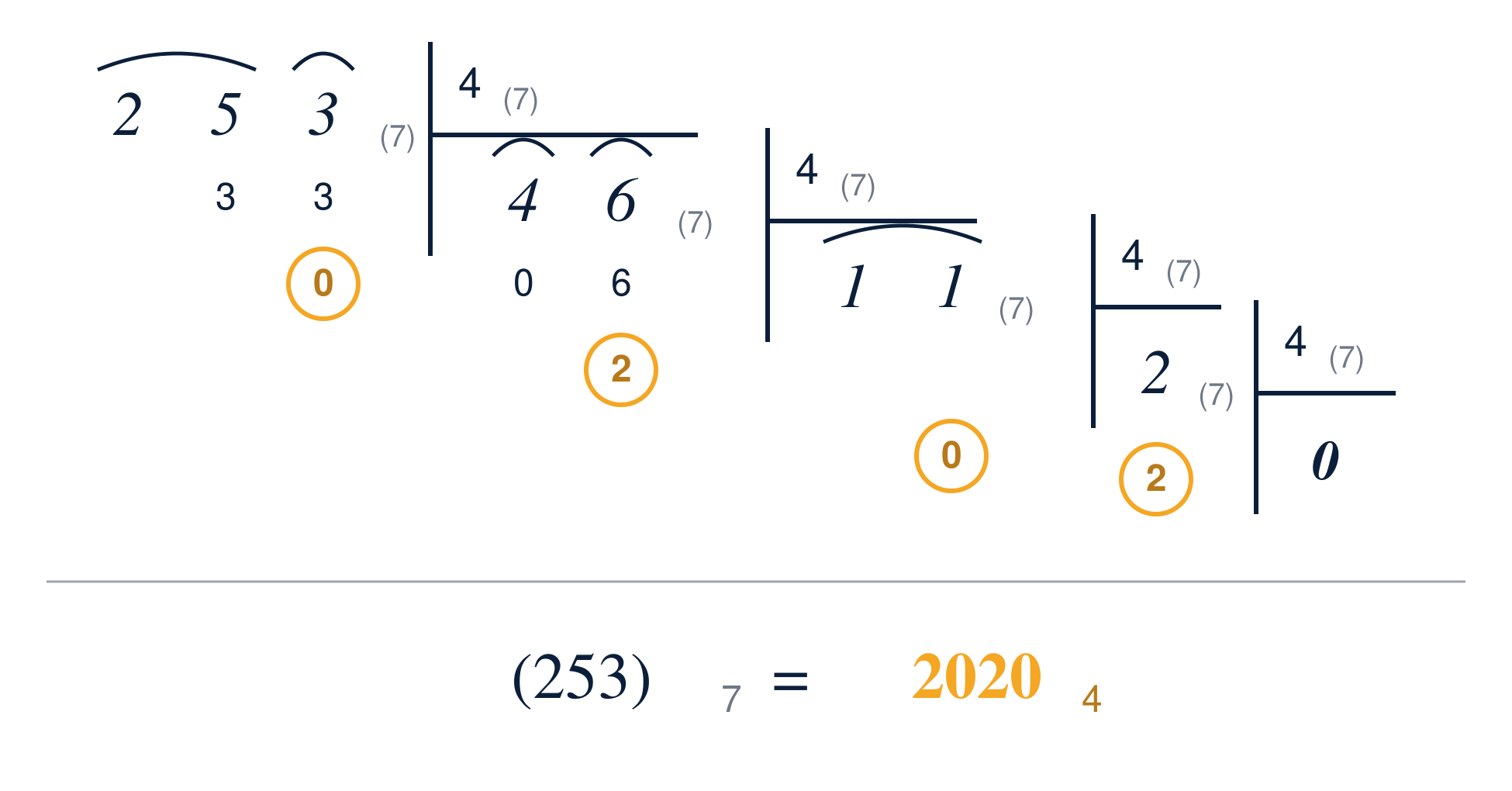
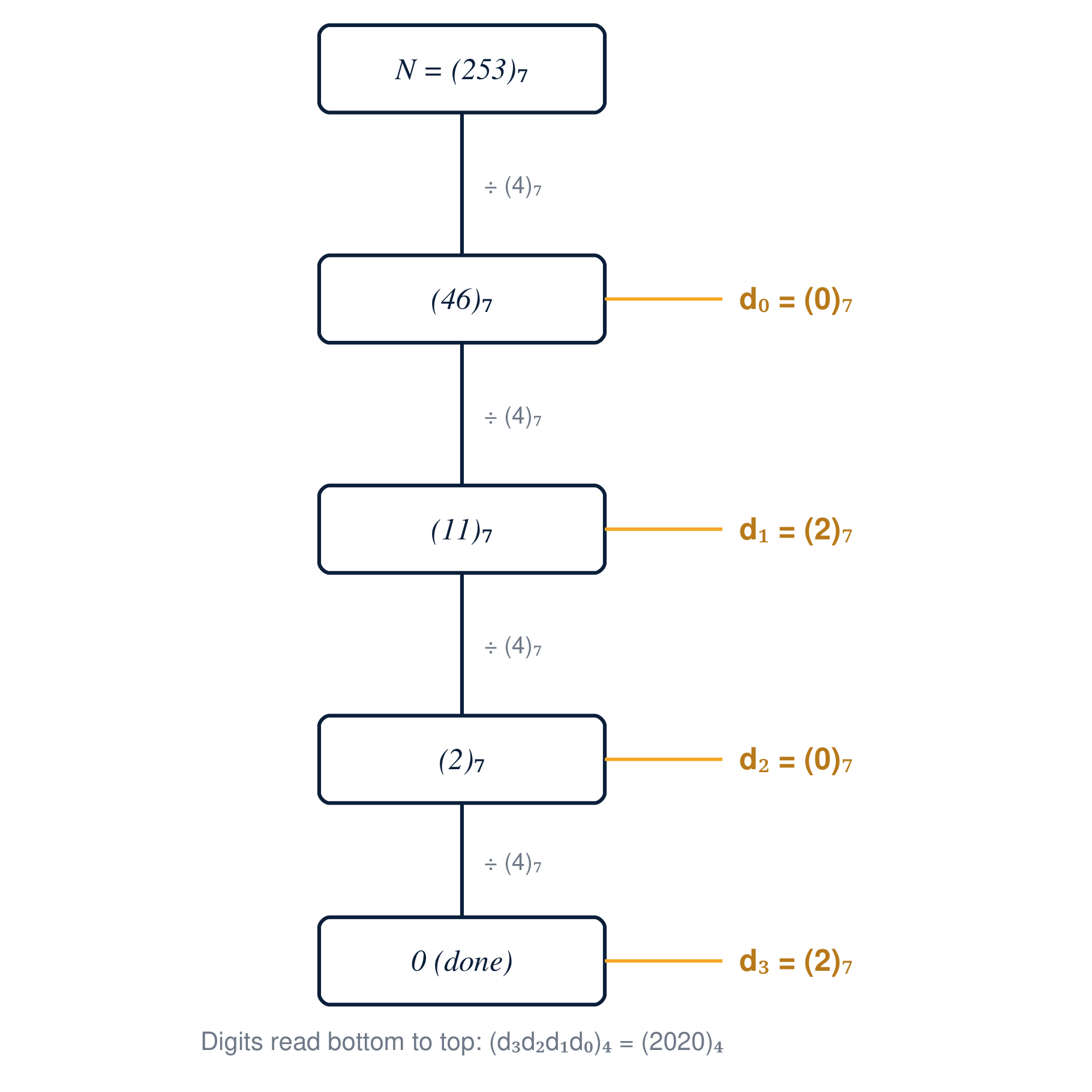
Reading the digits in the order d₃d₂d₁d₀ (Section 3):
(253)₇ = (2020)₄
(Check, as a final sanity test: (253)7 equals 136 in base ten -- Example 1.1 -- and 2·4³+0·4²+2·4¹+0·4⁰=128+0+8+0=136. ✓)
This conversion required exactly 4 divisions (one for each digit produced in base 4), carried out entirely in base-7 arithmetic: no base other than 7 (for the starting point) and 4 (for the result) ever appeared in the computation -- not even implicitly, as an intermediate value.