6. Direct conversion between arbitrary bases
Nothing in the argument of Sections 3–4 depended on the specific values 7 and 4: the same principle applies to a direct conversion between any two bases a and b, a,b≥2, with no need to pass through base ten or through any other intermediate base. One only needs the value of N (obtained by applying Definition 1.1 to its representation in base a), to which the successive-division method with target base b is then applied.
Example 6.1
Let N=(2314)5, a number written in base 5. We want to convert it directly into base 9. Note that 9, written in base 5, is (14)5 (since 9=1·5+4): the divisor is thus expressed with two digits in base 5, and long division requires -- as with the usual division by a two-digit divisor in base ten -- estimating the quotient digit, followed by multiplication and subtraction (with a possible borrow), all in base-5 arithmetic.
Multiples of (14)5 useful for the estimation (computed by repeated addition in base 5):
| d | 1 | 2 | 3 | 4 |
|---|---|---|---|---|
| (14)₅×d | (14)₅ | (33)₅ | (102)₅ | (121)₅ |
Native base-5 long division of (2314)5 by (14)5. The diagram below chains the three rounds into a single staircase, with the same logic as Section 3: at each sub-step, the minimum number of leading digits needed to reach the divisor is grouped (a wide arc, as on "23" and on the whole of "122" at the second step), or a single digit is brought down at a time when the first digit is already enough on its own (separate small arcs, as on "1" and "4" in the first step); the remainder of each sub-step is rewritten next to the following digit brought down, forming the new value to be divided. The difference from Section 3 is that the divisor here has two digits: each sub-step therefore requires estimating the quotient digit from the table of multiples above, rather than an immediate choice.
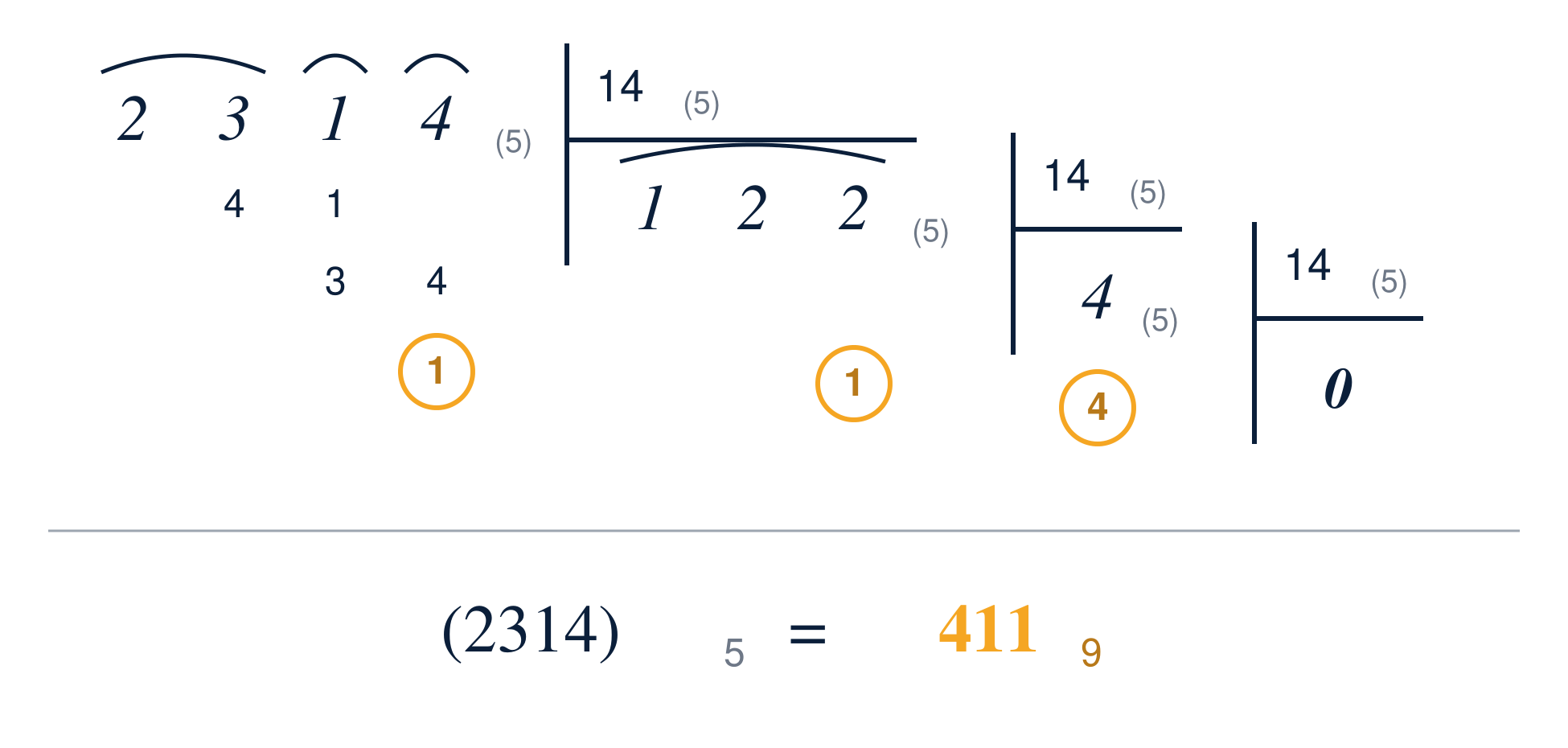
Reading the digits in the order d₂d₁d₀ (Section 3):
(2314)₅ = (411)₉
Check (entirely in base 5, reconstructing the last non-trivial round backwards): quotient times divisor plus remainder must give back the dividend of that round, i.e. (4)5×(14)5+(1)5. From the table, (4)5×(14)5=(121)5; adding the remainder, (121)5+(1)5=(122)5 (units 1+1=2, the other digits unchanged) -- exactly the N₁ found in the first round. ✓
Once again no intermediate base appeared in the computation: from base 5 to base 9, directly -- this time with a multi-digit divisor, a case that Section 3 (where the divisor had a single digit) had not yet presented.