Mathematical Analysis
    15 min read
    August 2026

    A Reciprocity Formula for Integrals of Symmetric Functions

    A functional reciprocity formula that simplifies definite integrals over symmetric intervals, generalizing a classic competition-math trick.

    3. Examples

    We now apply Theorem 1 to three concrete cases of increasing complexity. In each one we first check that g satisfies functional reciprocity, then apply the formula directly.

    Example 1

    Let f(x) = x2 and g(x) = ex. Since g(-x) = e-x = 1/ex = 1/g(x), the condition is satisfied (this is the case already discussed in Observation 1, with h(x) = x). Theorem 1 gives:
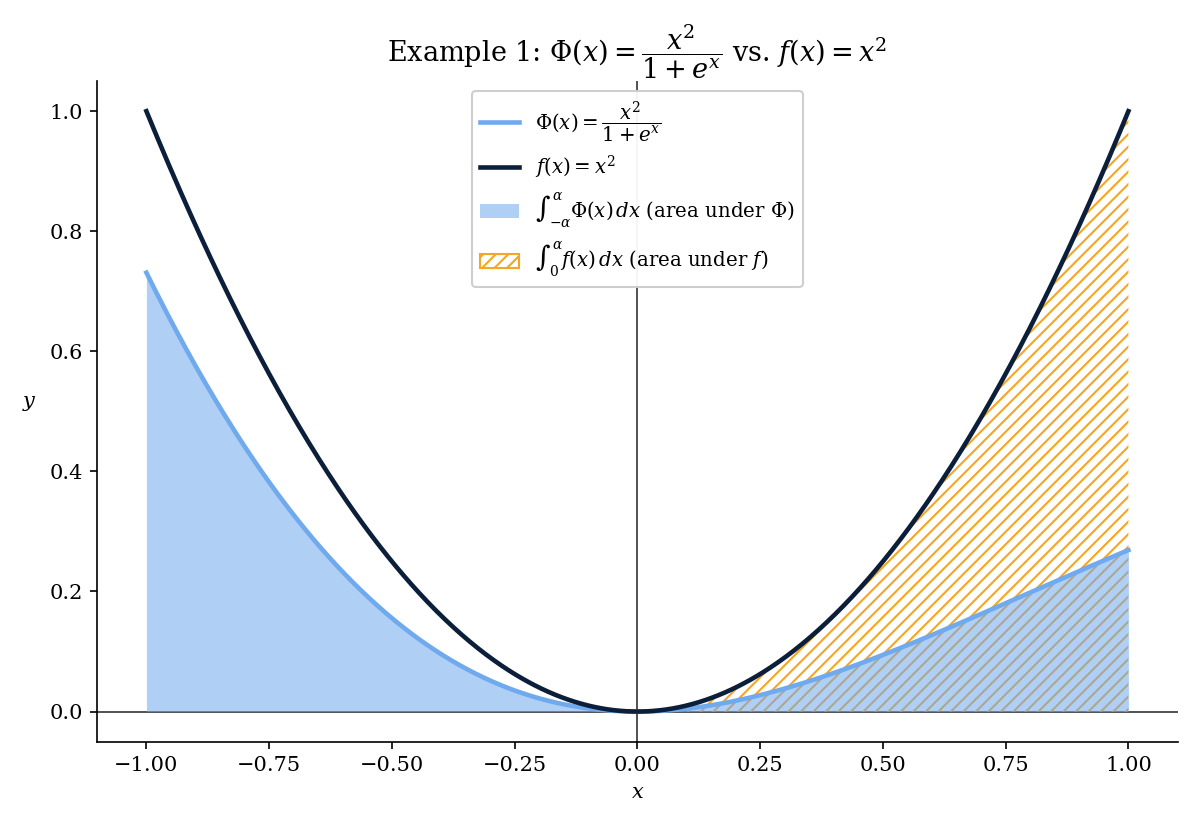
    ∫−11x21+ex dx=∫01x2 dx=13.\int_{-1}^1 \frac{x^2}{1+e^x}\,dx = \int_0^1 x^2\,dx = \frac{1}{3}.
    Graph comparing Φ(x)=x²/(1+eˣ) on [-1,1] with f(x)=x² on [0,1], with the two equivalent areas highlighted
    Figure 1. The blue area under Φ(x)=x²/(1+eˣ) over the whole interval [-1,1] and the (hatched) area under f(x)=x² over [0,1] have the same value, 1/3: the region where the two areas overlap (hatching over the blue fill, on [0,1]) highlights the shared part.

    Example 2

    Let f(x) = x2 + cos x and g(x) = ex cos x. Here h(x) = x cos x is odd (the product of an odd function, x, and an even one, cos x), so by Observation 1 the condition is automatically satisfied. Theorem 1 gives:
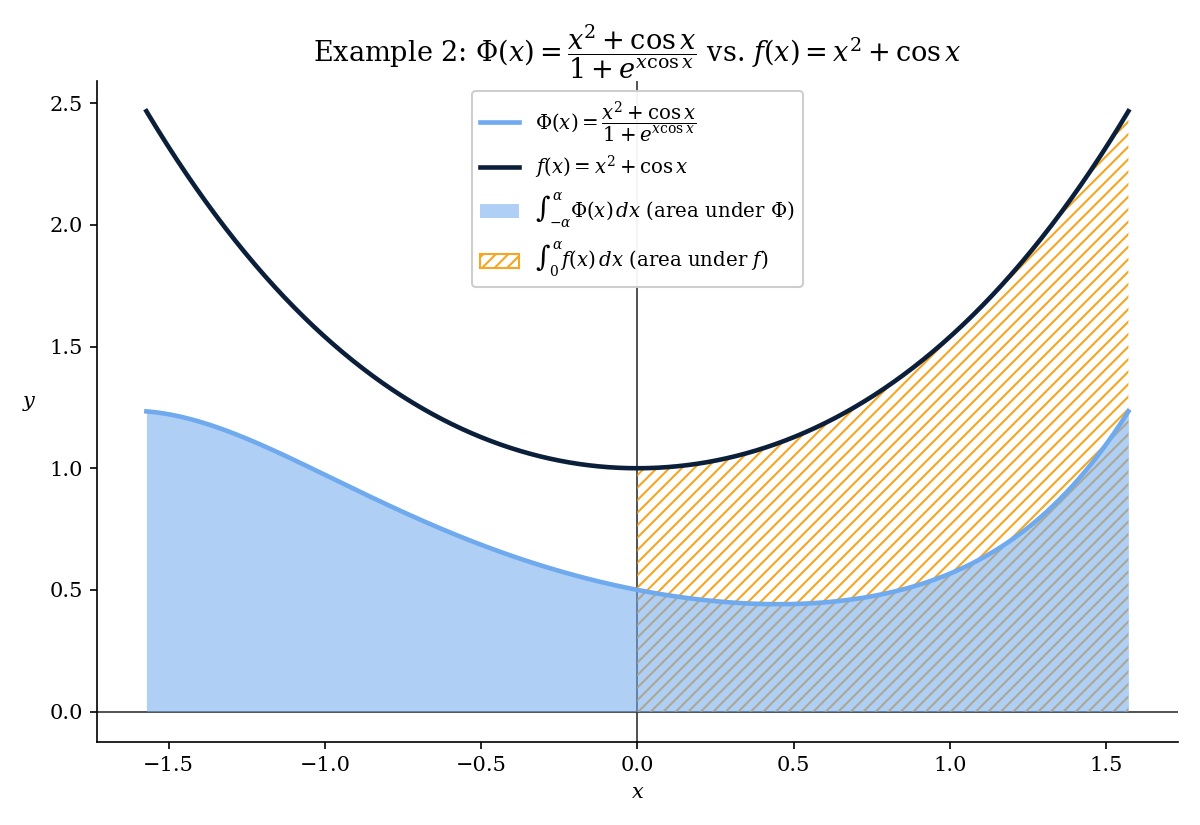
    ∫−π/2π/2x2+cos⁡x1+excos⁡x dx=∫0π/2(x2+cos⁡x) dx=π324+1.\int_{-\pi/2}^{\pi/2} \frac{x^2+\cos x}{1+e^{x\cos x}}\,dx = \int_0^{\pi/2}(x^2+\cos x)\,dx = \frac{\pi^3}{24}+1.
    Graph comparing Φ(x)=(x²+cos x)/(1+e^(x cos x)) with f(x)=x²+cos x, with the two equivalent areas highlighted
    Figure 2. Same scheme for a more complex transcendental integrand: the area under Φ over the whole interval [-π/2,π/2] and the area under f over [0,π/2] coincide, with the shared part highlighted by the overlap on [0,π/2].

    Example 3

    Let f(x) = x2 and g(x) = (1+x2)x. One checks directly that g(-x) = (1+(-x)2)-x = (1+x2)-x = 1/g(x) (here g is not of the form eh(x) with h odd from Observation 1: this is an example of reciprocity verified directly, not through that shortcut). Theorem 1 gives:
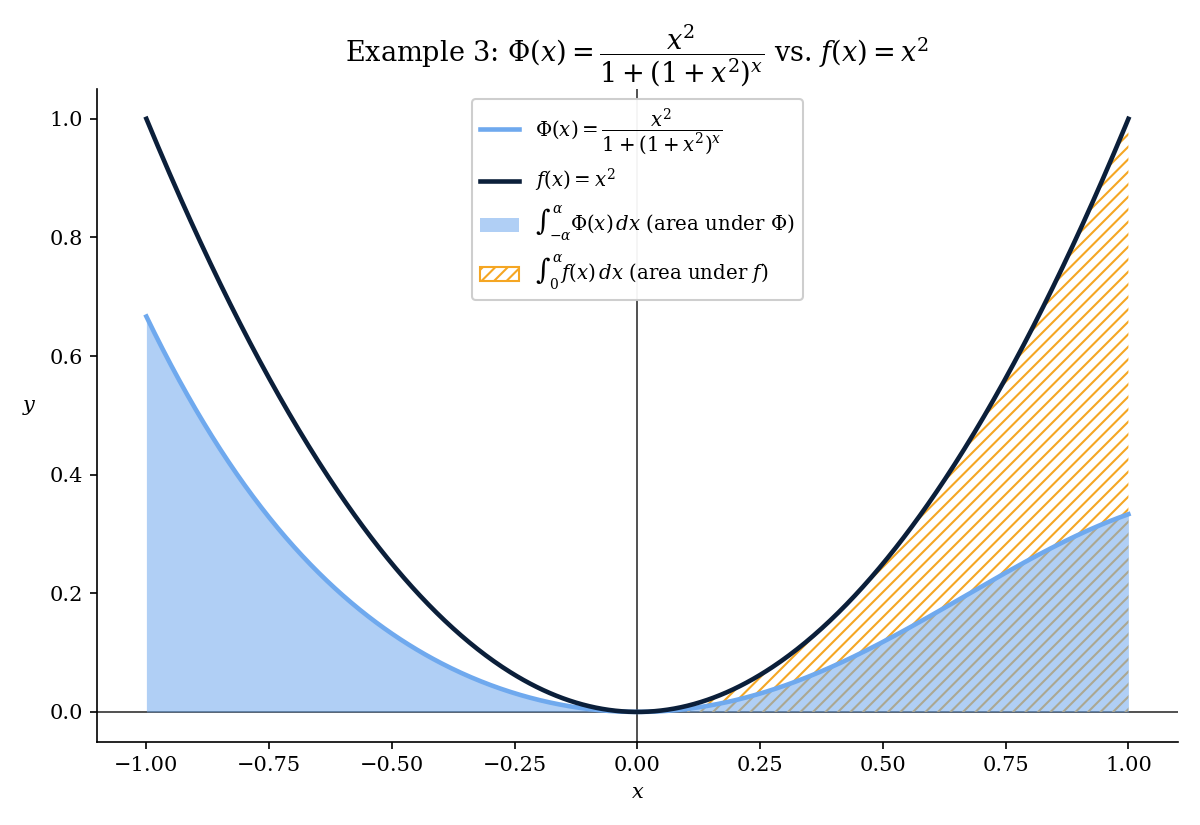
    ∫−11x21+(1+x2)x dx=∫01x2 dx=13.\int_{-1}^1 \frac{x^2}{1+(1+x^2)^x}\,dx = \int_0^1 x^2\,dx = \frac{1}{3}.
    Graph comparing Φ(x)=x²/(1+(1+x²)ˣ) with f(x)=x², with the two equivalent areas highlighted
    Figure 3. Application to an integrand built from a power function: here too the area under Φ over [-1,1] and the area under f over [0,1] both measure 1/3, with the overlap visible over [0,1].

    Counterexample 1 (What happens when reciprocity fails)

    If g does not satisfy g(-x) = 1/g(x), there is no reason for Theorem 1's equality to hold — and in general it doesn't. Let f(x) = x2 and g(x) = ex + 1 (a function that looks like the one in Example 1, but with one too many +1's). We have g(-x) = e-x+1, while 1/g(x) = 1/(ex+1): these differ for every x (their equality would require ex+e-x+1=0, impossible for real x, since ex+e-x ≥ 2). Functional reciprocity fails everywhere, and indeed

    ∫−11x22+ex dx≈0.2155 ≠ 13=∫01x2 dx.\int_{-1}^1 \frac{x^2}{2+e^x}\,dx \approx 0.2155 \ \ne\ \frac{1}{3} = \int_0^1 x^2\,dx.

    This time the two areas do not coincide: functional reciprocity is therefore not a superfluous technical hypothesis, but the precise structural condition that makes the simplification possible.

    Comments

    Loading comments...

    Won't be published: only used for contact and moderation.

    0/3000 characters

    Anti-spam check in progress…

    © 2026 keenonmaths.org. Empowering mathematical minds worldwide.

    Educational articles are distributed under a Creative Commons BY-NC-ND 4.0 license.