The problem
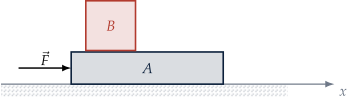
A block A of mass rests on a horizontal surface, and a block B of mass rests on top of it. Between A and the surface the coefficients of static and kinetic friction are and respectively; between B and A they are and . Air resistance is negligible. With the system initially at rest, a constant horizontal force is applied to block A (see figure). The system is said to be in motion if at least one of the two blocks moves relative to the surface.
- Find the value of the magnitude of above which the system starts to move.
- Find the maximum value for which B, with the system in motion, does not slip on A. Discuss, as the parameters vary, whether there are values of for which the system moves without B slipping.
- For the values of for which B slips on A, find the accelerations of the two blocks relative to the surface.
- Repeat points 1–3 assuming that is applied to block B.
- Numerical application. Work through the previous points with the data: (a) , , , , , ; (b) , , , , , . Take .
In this first part we tackle points 1–3 (and the corresponding numerical application) with the force applied to A; the second part deals with the case in which the force acts on B. Whether the force pushes the block, as in the figure, or pulls it, for instance through a horizontal rope, makes no difference: the whole argument depends only on the force being horizontal and on which block receives it.
Conventions
- The supporting surface serves as the horizontal -axis, pointing in the direction of (Figure 1): a force or an acceleration is positive if it points that way. For horizontal forces we write magnitudes directly, stating the direction in words or in the figure.
- All accelerations are measured relative to the surface (the ground).
- denotes the total mass of the system.
- In the friction coefficients, the first subscript indicates the contact surface (A: between A and the ground; B: between B and A), the second the type of friction: for static, for dynamic (often written , for kinetic).
- We work symbolically until the end; numerical values are substituted only into the final formulas. We use .
- Numerical results are given to three significant figures (one more than the data), so that close values can be compared meaningfully.
The strategy in brief
- Section 1 — The forces at play. Isolate each block and draw its free-body diagram: everything else follows from here.
- Section 2 — When the system starts moving. As long as everything is at rest, A and B behave as a single body: we just compare with the maximum static friction of the ground.
- Section 3 — When B does not slip. B is accelerated only by the friction exerted by A, which has a maximum value: this limits the common acceleration.
- Section 4 — When B slips. The blocks have different accelerations: Newton's second law is written separately for each, with kinetic friction between them.
- Section 5 — Numerical application. The symbolic results applied to the two data sets, plus a case built on purpose in which B slips right from the start.
1. The forces at play
Where we are. The system is at rest and the force acts on A. Before computing anything, we need to know exactly which forces act on each block.
Goal. List the forces acting on A and on B and find the normal forces.
Idea. We ideally isolate each block and draw all and only the forces acting on it (free-body diagram). The forces the two blocks exert on each other appear in both diagrams, with opposite directions.
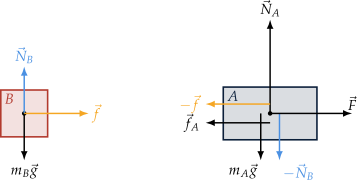
- Forces on B (Figure 2). Acting on B are its weight , the normal force exerted by A (upward) and the friction force exerted by A. The direction of : when A moves (or tends to move) to the right, it "carries B along", so the friction on B points in the direction of . With the system at rest, however, we will see in Section 2 that . It is the only horizontal force on B: without it, B would stay put while A slides out from underneath.
- Forces on A. Acting on A are its weight , the force , the normal force of the ground and the ground friction , opposite to the motion (or tendency to move) of A. In addition, by Newton's third law (Memento M1), B exerts on A a downward pressing force and a friction force pointing left.
- Normal forces. Neither block moves vertically, so the vertical forces on each block balance. For B: . For A, the ground must support both the weight of A and the push of B:
Memento M1 — Newton's third law
If a body A exerts a force on a body B, then B exerts on A a force : same magnitude, same line of action, opposite direction. The two forces act on different bodies, so they never cancel out in the diagram of a single body. The law holds for any interaction between two bodies, whether or not they belong to an isolated system, and therefore also for normal forces and friction forces.
Friction forces obey the laws recalled below: the distinction between static and kinetic friction will be at the heart of the whole exercise.
Memento M2 — Static and kinetic friction
Consider two surfaces in contact, with normal force .
- If the surfaces do not slide over each other, friction is static: its magnitude is exactly what is needed to prevent sliding, as long as it does not exceed a maximum value:
- If the surfaces slide, friction is kinetic (dynamic): its magnitude isand it opposes the relative velocity of the surfaces.
Usually : setting a body in motion takes more than keeping it moving.
Watch out
The normal force of the ground on A is not : the ground supports the whole system, so . Using in the ground friction is one of the most common mistakes in this kind of exercise.
Check. Consider A and B as a single system. The forces they exchange ( and ) are internal and cancel in pairs (Memento M3); vertically we are left with the total weight and the normal force of the ground, which again gives . ✓
Memento M3 — Newton's second law for a system of bodies
If several bodies move with the same acceleration , they can be treated as a single body whose mass is the total mass:
Only external forces appear in the sum: those the bodies exert on each other cancel in pairs by Newton's third law (Memento M1). The system does not need to be isolated: the system A+B is not, since the weight, and the ground forces act on it, yet the internal forces still cancel. If instead the bodies have different accelerations, the second law must be written separately for each of them.
Historical note
The laws of sliding friction have a long history. Leonardo da Vinci, in his notebooks, observed that friction does not depend on the size of the contact area and estimated its magnitude at about a quarter of the body's weight. His notes, however, remained unpublished for centuries, and the same laws were rediscovered independently by Guillaume Amontons, who presented them to the Paris Academy of Sciences in 1699: friction is proportional to the load and independent of the apparent contact area. Charles-Augustin de Coulomb, in a memoir awarded a prize by the same Academy in 1781, systematised them and clearly distinguished friction at the onset of motion (static) from friction during sliding (kinetic). This is why the laws we use are often called the "Amontons–Coulomb laws".
Let's recap
- On B the only horizontal force is the friction exerted by A, pointing in the direction of .
- Horizontally, A is acted on by , the ground friction and the reaction to the friction on B.
- Normal forces: , .
2. When the system starts moving
Where we are. We know all the forces and the normal forces. The system is at rest.
Goal. Find , the value of above which the system starts to move (point 1).
Idea. As long as everything is at rest, A and B have the same (zero) acceleration and can be treated as a single body (Memento M3). The only external horizontal force opposing is the ground friction, which is static and therefore has a maximum value.
- Equilibrium of the system. The external horizontal forces are and . For the system to stay at rest we need
- Limit of static friction. By Memento M2, the static friction of the ground cannot exceed . The system therefore stays at rest if and only if
- Threshold. It follows thatFor block A starts to move.
- What about block B? As long as the system is at rest, each block is in equilibrium: by Newton's first law, the net force acting on it is zero. The only horizontal force on B is the static friction exerted by A, so with the system at rest we must have : the friction between the blocks is not called into play, and the whole force is balanced by the ground. As soon as A starts moving, B must accelerate with it, and the only force that can do this is precisely the friction from A: becomes non-zero and drags B forward. So B moves relative to the ground in any case. What remains to be seen is whether it moves together with A or slips on it: this is the question of point 2, and the answer is not obvious.
Check.
- Dimensions of (1): is dimensionless and is a force, so is a force. ✓
- Limiting case (perfectly smooth ground): (1) gives , i.e. any force sets the system in motion. ✓
- (1) depends on the total mass: to move A we must overcome the friction due to the entire weight pressing on the ground, consistently with the Watch out box of Section 1. ✓
Let's recap
- The system stays at rest as long as the static friction of the ground can balance .
- .
- Beyond the threshold A starts moving and drags B; whether B slips or not is decided in the next section.
3. When B does not slip
Where we are. For the system is in motion. We ask whether B manages to follow A.
Goal. Find , the maximum value of for which B does not slip on A, and discuss when there are values of with the system in motion and B moving together with A (point 2).
Idea. B is accelerated only by the friction A exerts on it. If B does not slip, that friction is static and has a maximum value: so there is a limit to the acceleration A can "transmit" to B. We just need to compare this limit with the acceleration the system would have moving as a single block.
- Acceleration of B. Suppose A and B move together with acceleration . The only horizontal force on B is the friction exerted by A, and it is static friction, because B does not slide on A. Newton's second law applied to B alone givesWatch out: this value is not . Static friction is "as much as needed" to prevent sliding, here exactly as much as is needed to give B the acceleration ; is only its maximum value (Memento M2), reached in the limiting condition of step 4. Writing from the start would lead to wrong results.
- Limit set by static friction. By Memento M2, . Substituting:The mass of B cancels: B does not slip if and only if the common acceleration does not exceed , whatever the masses.
- Acceleration of the system. The system is in motion, so the ground friction is now kinetic: . By Memento M3:
- Condition on . Imposing :that is
- Are there "good" values of ? We need forces that set the system in motion (, formula (1)) without making B slip (, formula (2)). The interval is non-empty if and only if , that is
- Interpretation. At the instant A breaks loose, the ground friction switches from static to kinetic and "drops" abruptly from to . Even with just above the threshold, the acceleration of the system does not start from zero but fromIf this jump exceeds , B cannot follow A from the very first instant: there is no force that sets the system in motion without making B slip. A numerical example of this situation is given in Section 5.
Check.
- Dimensions of (2): is dimensionless and is a force, so is a force. ✓
- Limiting case (B resting on a perfectly smooth surface): (2) gives and (3) is not satisfied, so the window does not exist and B always slips. Reasonable: without friction, nothing can drag B along. ✓
- Case (no jump between static and kinetic): (3) becomes , always true. The window always exists. ✓
Let's recap
- B follows A only if the common acceleration does not exceed , regardless of the masses.
- .
- There are forces that move the system without making B slip if and only if : the "jump" in ground friction at the start must not exceed what the friction between the blocks can withstand.
4. When B slips
Where we are. If exceeds (or, when the window does not exist, as soon as exceeds ), B slips on A.
Goal. Find the accelerations and of the two blocks (point 3).
Idea. Now the blocks have different accelerations: Memento M3 can no longer be applied to the system, and the second law must be written separately for each block, starting from new free-body diagrams. The friction between the blocks is kinetic, so its magnitude is known.
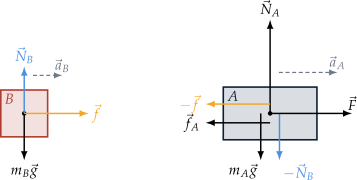
- What changes compared with Figure 2. In the new diagrams (Figure 3) the forces are the same and have the same directions, but now the frictions are kinetic, so their magnitudes are known, and the two blocks have different accelerations. The direction of the friction between the blocks is the same as before: A accelerates more than B and "slides ahead" of it: relative to A, B moves backward. The kinetic friction on B opposes this relative motion, so it points forward (in the direction of ), with magnitude . The reaction acts on A, backward (Memento M1).
- Block B. The vertical forces on B balance, so . Horizontally, only the kinetic friction from A acts, forward, with magnitude (Memento M2). Newton's second law along gives:
- Block A. The horizontal forces on A are forward and, backward, the reaction to the friction on B, with magnitude (Memento M1), and the kinetic friction of the ground, with magnitude . Newton's second law along gives:
- Consistency of the assumption. We assumed that A is faster than B, i.e. . Substituting and multiplying by :This condition is always satisfied whenever B slips: if the window exists, by (2) because ; if the window does not exist, and the same argument applies. ✓
Check.
- Dimensions: in (4) is a pure number times , hence an acceleration; in the numerator of (5) all terms are forces, divided by a mass. ✓
- (4) shows that does not depend on : once B slips, increasing does not accelerate B any more. The only horizontal force on B is kinetic friction, whose magnitude is fixed.
- For (blocks separated by a smooth surface) (4) and (5) give and . B stays put while A slides underneath, still pressing on the ground with the weight of B. ✓
Fun fact
The famous trick of whipping a tablecloth out from under the dishes without knocking them over is exactly this situation: the tablecloth is A, the dishes are B. Pulling hard, the tablecloth accelerates enormously, but the dishes cannot have an acceleration greater than , whatever the force. If the pull is quick enough, the tablecloth is gone before the dishes have gained any appreciable speed, and they move only a few millimetres. The secret lies entirely in speed, not in force: and a smooth, hemless tablecloth and heavy dishes help a lot.
Let's recap
- When B slips, the blocks must be treated separately, with kinetic friction between them.
- , independent of and of the masses.
- , and it always turns out that .
5. Numerical application
Goal. Apply the results of Sections 2–4 to the two data sets of point 5 and to a third set illustrating the case with no window.
In all the data sets of this part , so .
Data (a)
, , , , , .
- Starting threshold, formula (1).
- Slipping threshold, formulas (3) and (2). : the window exists.
- A value inside the window, :less than . ✓ The friction on B is , below the maximum of .
- A value beyond the window, , formulas (4) and (5):✓ .
Data (b)
, , , , , .
- Starting threshold, formula (1).
- Slipping threshold, formulas (3) and (2). : the window exists.
- A value inside the window, :✓
- A value beyond the window, , formulas (4) and (5):✓ .
Compared with data (a), the window is lower in absolute terms (from to instead of from to ), but much wider in relative terms: is almost four times , against twice for data (a). The reason is the small jump between and and the high .
A case with no window
We keep the masses of data (a) and the coefficients between the blocks (, ), but assume a ground with and . The jump between static and kinetic friction is deliberately exaggerated, to make the effect evident: it is not a typical value.
- Starting threshold, formula (1).
- The window does not exist, formula (3). . Indeed, the formula for would givea value less than .
- Direct check, with , just above the threshold. If the blocks moved together we would havegreater than : the assumption is false, and B slips from the start.
- Actual accelerations, formulas (4) and (5).✓ .
Let's recap — Part 1
With the force applied to the lower block A:
| Result | |
|---|---|
| Start | (1) |
| B does not slip | (2) |
| Existence of the window | (3) |
| B slips | (4), (5) |
In the second part we will see that, by moving the force to the upper block, the structure of the problem changes completely.