Part 2 — The force acts on the upper block (B)
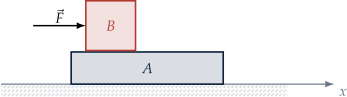
We return to the problem of Part 1 (same masses, same coefficients, same conventions), but now the constant horizontal force is applied to the upper block B (point 4 of the problem). Mementos M1–M3 still apply.
The strategy in brief
- Section 6 — The forces at play, again. New free-body diagrams: now the friction between the blocks slows B down and drags A along.
- Section 7 — When the system starts moving, again. The system can start in two ways, with B sliding on A or with A sliding on the ground: the threshold is the lower of the two, and this distinguishes two regimes.
- Section 8 — When B does not slip, again. In the first regime the question has no answer; in the second we compute the friction B needs to drag A along.
- Section 9 — When B slips, again. For B the calculation is immediate; for A we must first see whether the friction it receives is enough to break it loose from the ground.
- Section 10 — Numerical application. The two data sets, which here fall into opposite regimes.
6. The forces at play, again
Where we are. The situation is that of Part 1, but acts on B.
Goal. Redraw the free-body diagrams and understand what changes.
Idea. The vertical forces do not change ( is horizontal); what changes are the directions of the friction forces between the blocks, because now it is B that "drags" A and not the other way round.
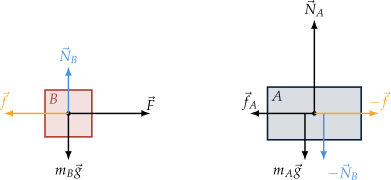
- Forces on B (Figure 5). Weight , normal force , the force forward and the friction exerted by A, which opposes B's tendency to slide forward: so it points backward.
- Forces on A. Weight, ground normal force , pressing force and ground friction backward. By Newton's third law (Memento M1), the friction from B on A points forward: it is now the only horizontal force that can set A in motion.
- Normal forces. Unchanged: and .
Check. On the system A+B the external horizontal forces are still only and : from the point of view of the system as a whole, applying the force to A or to B makes no difference. The whole difference lies in how the force is transmitted between the blocks. ✓
Let's recap
- Normal forces unchanged: , .
- The friction between the blocks slows B down and drags A along: the directions are opposite to those of Part 1.
- A can move only thanks to the friction from B, whose magnitude is limited.
7. When the system starts moving, again
Where we are. The system is at rest and acts on B.
Goal. Find (point 4, repeating point 1).
Idea. Now the system can start moving in two ways: B slides on A, or A (with B on top) slides on the ground. The system stays at rest only if both static frictions hold: the threshold is the lower of the two.
- Equilibrium of B. If B is at rest, by Newton's first law the net horizontal force on B is zero: the static friction from A must exactly balance , i.e. . By Memento M2 we need .
- Equilibrium of the system. If everything is at rest, the net external force on the system A+B is also zero (Memento M3, with zero acceleration): the static friction of the ground balances , i.e. . We need .
- Threshold. Everything stays at rest if and only if both conditions hold, so
- Who moves first: two regimes.
- Regime (i): . The lower threshold is the one between the blocks: , and it is B that starts moving, sliding on A. Block A stays at rest: from B it receives at most the kinetic friction , which does not exceed , and so is not enough to overcome the static friction of the ground.
- Regime (ii): . The lower threshold is that of the ground: , and it is A that starts moving, with B on top.
- When are we in regime (ii)? Let us rewrite the condition asThe right-hand side is positive, so we need at least (B grips A better than A grips the ground) and, in addition, B must be heavy enough compared with A.
Check.
- Dimensions of (6): both terms of the minimum are a mass times a dimensionless coefficient; multiplied by they give a force. ✓
- Limiting case with : the regime (ii) condition becomes , true. Reasonable: if A has no mass, it is as if B rested directly on the ground with a "mat" in between, and it slides where friction is lower. ✓
Let's recap
- .
- Regime (i): B starts, sliding on A; A stays at rest.
- Regime (ii), possible only if and B is heavy enough: A starts, with B on top.
8. When B does not slip, again
Where we are. We know the starting threshold and the two regimes.
Goal. Find , if it exists (point 4, repeating point 2).
Idea. In regime (i) the answer is immediate: the system starts moving precisely because B slips. In regime (ii) we reason as in Section 3: we assume the blocks move together and compute how much static friction B needs.
- Regime (i). The system moves only when B slips on A: there is no value of for which the system moves without B slipping. Point 2 has no answer.
- Regime (ii): common acceleration. For the blocks start together (we check this in step 5). The ground friction is kinetic, and by Memento M3
- Friction needed on B. Horizontally, B is acted on by forward and by the friction exerted by A, backward; it is static friction, because B does not slide on A. As in Section 3, is as much as is needed to give B the common acceleration, not : the maximum value comes into play only in the limiting condition of step 4. Newton's second law for B gives , soThe friction needed increases with .
- No-slip condition. We impose :
- Consistency: the window always exists, and B does not slip at the start. Since increases with , it is enough to check that at the starting threshold the friction needed is below the maximum. For just above (formula (6), regime (ii)):The regime (ii) condition, , together with , givesthat is : at the start B follows A, and consequently . ✓
- Comparison with Part 1. There, the "jump" in ground friction at the start could make B slip immediately; here it cannot. The reason: when the force acts on B, the friction between the blocks only has to accelerate A, and the acceleration at the start is largely "paid for" directly by .
Check.
- Dimensions of (7): is a mass, multiplied by a dimensionless coefficient and by . ✓
- Limiting case : (7) gives . A massless block A needs no force to be accelerated, so B never slips. ✓
- In (7) depends on with a minus sign: a "rougher" ground during motion makes slipping easier, because A offers more resistance and B has to "drag" it harder. ✓
Let's recap
- Regime (i): does not exist; the system moves only with B slipping.
- Regime (ii): , always greater than .
- Unlike Part 1, B never slips at the start: the window always exists in regime (ii).
9. When B slips, again
Where we are. B slips on A: in regime (i) for , in regime (ii) for .
Goal. Find and (point 4, repeating point 3).
Idea. As in Section 4, we write the second law separately for the two blocks, with kinetic friction between them. For B it is immediate. For A there is an extra question: is the friction it receives from B enough to set it in motion?
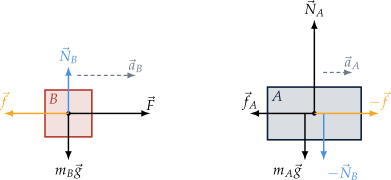
- Block B (Figure 6). The vertical forces on B balance, so . Horizontally, acts forward and the kinetic friction from A acts backward, with magnitude (Memento M2). Newton's second law along gives:
- Block A: does it start or not? The only force pushing A forward is the kinetic friction from B, of magnitude , independent of . A is initially at rest, so this force must be compared with the maximum static friction of the ground, .
- If : A stays at rest, . This always happens in regime (i) (Section 7, step 4) and can also happen in regime (ii): we call this sub-case (ii-b). It requires a large jump between and .
- If (sub-case (ii-a)): A starts moving, and now the ground friction is kinetic, with magnitude , pointing backward. Newton's second law along for A gives:
- Consistency in sub-case (ii-a). We assumed that B slides forward relative to A, i.e. . Multiplying by and simplifying, the condition becomesalways satisfied because the right-hand side does not exceed from (7) (just compare them: ). ✓
Watch out
To decide whether A starts, the friction received from B must be compared with the static friction of the ground (), not the kinetic one: A is at rest, and must first "break loose". Only afterwards, to compute its acceleration, do we use . Mixing up the two steps leads to setting A in motion when in fact it stays at rest.
Check.
- Dimensions: in (8) is an acceleration, like ; in (9) the ratio of masses is dimensionless and multiplies . ✓
- (9) shows that, in sub-case (ii-a), does not depend on : this is the counterpart of what we saw in Part 1 for . The block that does not receive the force directly is moved only by kinetic friction, whose magnitude is fixed.
- In sub-case (ii-a) (9) gives , since . ✓
Let's recap
- .
- A starts only if , in which case , independent of ; otherwise .
- The block that does not receive the force directly is moved only by kinetic friction: its acceleration does not depend on .
10. Numerical application
Goal. Apply the results of Sections 7–9 to the two data sets. Here too .
Data (a)
, , , , , .
- Regime. , : we are in regime (i).
- Starting threshold, formula (6).B starts.
- Slipping threshold. It does not exist: every force that moves the system makes B slip.
- Accelerations, with , formula (8):: A receives from B onlyfar less than the needed to break it loose from the ground.
Data (b)
, , , , , .
- Regime. : regime (ii). Moreover : sub-case (ii-a).
- Starting threshold, formula (6).they start together.
- Slipping threshold, formula (7).
- A value inside the window, :The friction needed on B isbelow the maximum . ✓
- A value beyond the window, , formulas (8) and (9):✓ .
The same data that in Part 1 gave an ordinary window (data (a)) here remove it entirely; conversely, data (b), with B heavy and gripping A well, produce a huge window, from to .
Let's recap — The full picture
| on A | on B | |
|---|---|---|
| Start | (1) | (6) |
| B does not slip | (2) | only in regime (ii): (7) |
| Existence of the window | (3) | |
| B slips: block receiving | (5) | (8) |
| B slips: dragged block | (4) | (9) if , otherwise |
(.) Two ideas run through the whole exercise. The first: static friction is "as much as needed" and has only a maximum value, whereas kinetic friction has a fixed value. The second: the block that does not receive the force directly is moved only by friction, so its acceleration has a limit that no force can exceed.