3. Lipschitz Continuity
Definition 3.1 (Lipschitz function)
f: I → ℝ is Lipschitz continuous (with constant L) if there exists L ≥ 0 such that:
Proposition 3.1
Every Lipschitz-continuous function on I is uniformly continuous on I.
Proof. Let L be the Lipschitz constant. If L=0, f is constant and the claim is trivial. If L>0, given ε>0 it suffices to choose δ=ε/L: then |x−y|<δ ⇒ |f(x)−f(y)| ≤ L|x−y| < Lδ = ε.
∎
To construct examples of Lipschitz-continuous functions, the bounded-derivative criterion is useful, which follows from the Mean Value Theorem. It is worth clarifying right away the relationship between Rolle's theorem and the Mean Value Theorem (Lagrange), often presented imprecisely: from a logical point of view, Rolle's theorem is a special case of the Mean Value Theorem — it is obtained by setting f(a)=f(b) in the conclusion of the Mean Value Theorem, which then becomes f'(c)=0. The standard proof of the Mean Value Theorem, however, proceeds in the opposite direction, using Rolle's theorem (applied not to f but to a suitable auxiliary function that "straightens out" the chord between (a,f(a)) and (b,f(b))); for this reason Rolle's theorem is traditionally stated and proved first, even though, as stated, it is less general. We recall here only the statements of these two classical results (for the proofs, standard, see e.g. Rudin, Giusti, Fiorenza–Greco in the bibliography), because they are the direct ingredients of Corollary 3.1 which interests us.
Theorem 3.1 (Rolle)
Let f: [a,b] → ℝ be continuous on [a,b] and differentiable on (a,b), with f(a)=f(b). Then there exists c ∈ (a,b) such that f'(c) = 0.
Theorem 3.2 (Lagrange — Mean Value Theorem)
Let f: [a,b] → ℝ be continuous on [a,b] and differentiable on (a,b). Then there exists c ∈ (a,b) such that:
Corollary 3.1 (Bounded derivative ⇔ Lipschitz continuity, for differentiable functions)
Let I be an interval and f: I → ℝ differentiable on I. Then f is Lipschitz continuous on I with constant L if and only if |f'(x)| ≤ L for every x ∈ I.
Proof. (⇐) Let x,y ∈ I, x<y. Applying the Mean Value Theorem on [x,y] ⊆ I, there exists c ∈ (x,y) such that f(y)−f(x) = f'(c)(y−x). Then:
(⇒) Suppose f is Lipschitz continuous on I with constant L: |f(x)−f(y)| ≤ L|x−y| for every x,y ∈ I. Fix x ∈ I, for every h≠0 such that x+h ∈ I we have:Since f is differentiable at x, the difference quotient on the left converges to f'(x) as h→0; passing to the limit in an inequality (the absolute value is a continuous function) gives |f'(x)| ≤ L. Since x ∈ I is arbitrary, |f'(x)| ≤ L for every x ∈ I.
∎
Observation 3.2
The direction (⇒) just proved shows that there cannot exist a Lipschitz-continuous function that is differentiable on all of I with an unbounded derivative: if the derivative exists at every point of I, it is automatically bounded by the same Lipschitz constant. Lipschitz continuity can, however, coexist with isolated points of non-differentiability: for example f(x)=|x| is Lipschitz continuous on ℝ with L=1 but is not differentiable at 0. The equivalence in Corollary 3.1 therefore requires f to be differentiable on all of I, a hypothesis to be checked case by case.
Example 3.1 (f(x)=sin(x) is Lipschitz continuous on ℝ)
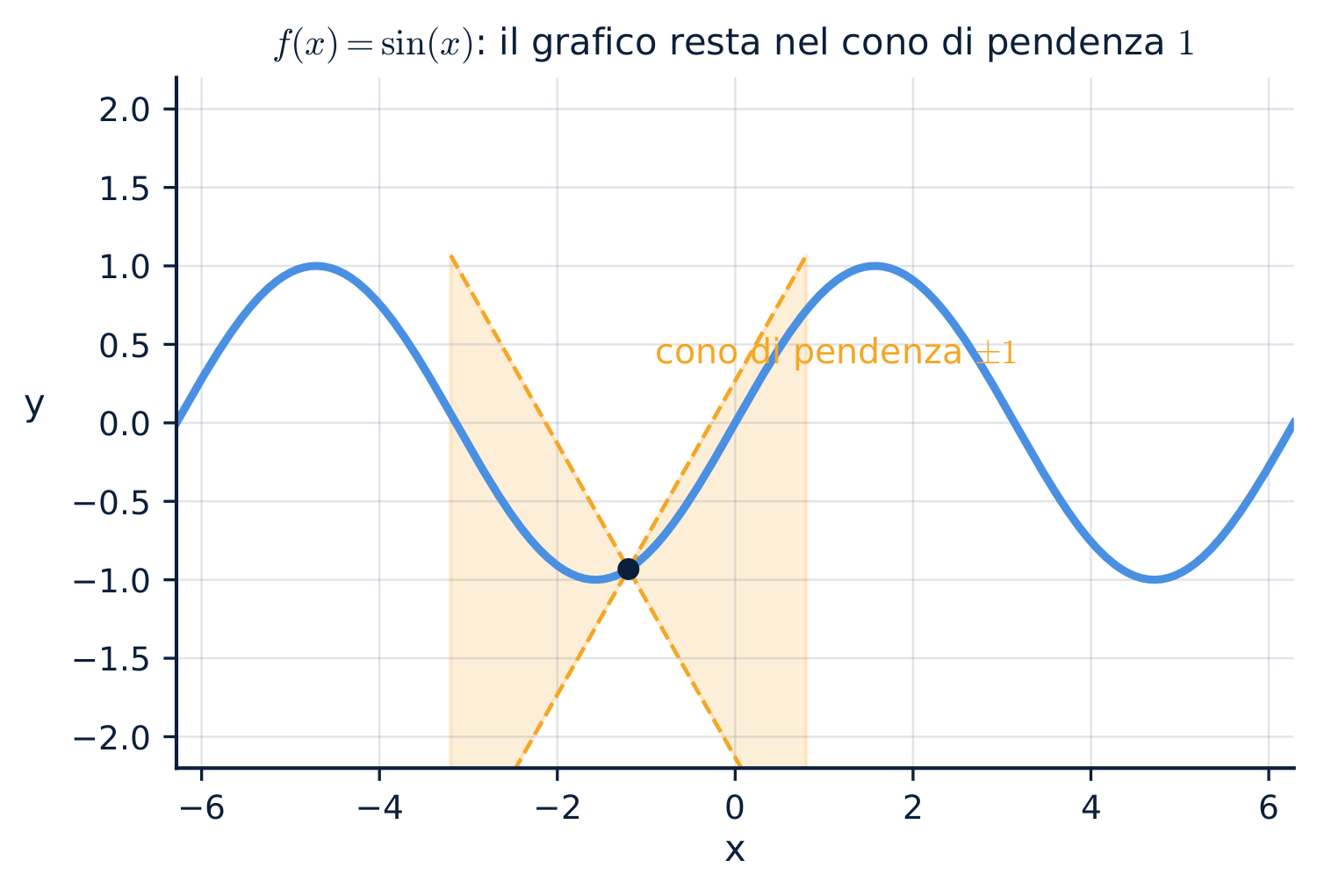
f(x) = sin(x) is differentiable on ℝ with f'(x) = cos(x), so |f'(x)| ≤ 1 for every x. By Corollary 3.1, sin is Lipschitz continuous on ℝ with constant L=1 (note: the inequality can also be proved directly, without going through differential calculus, using the sum-to-product formula sin x − sin y = 2cos((x+y)/2)sin((x−y)/2) and the elementary inequality |sin t| ≤ |t| for every t ∈ ℝ):
This argument applies, unchanged, to every differentiable function with bounded derivative: it is not a property specific to sin.
Counterexample 3.1 (f(x)=√x is not Lipschitz continuous on [0,1])
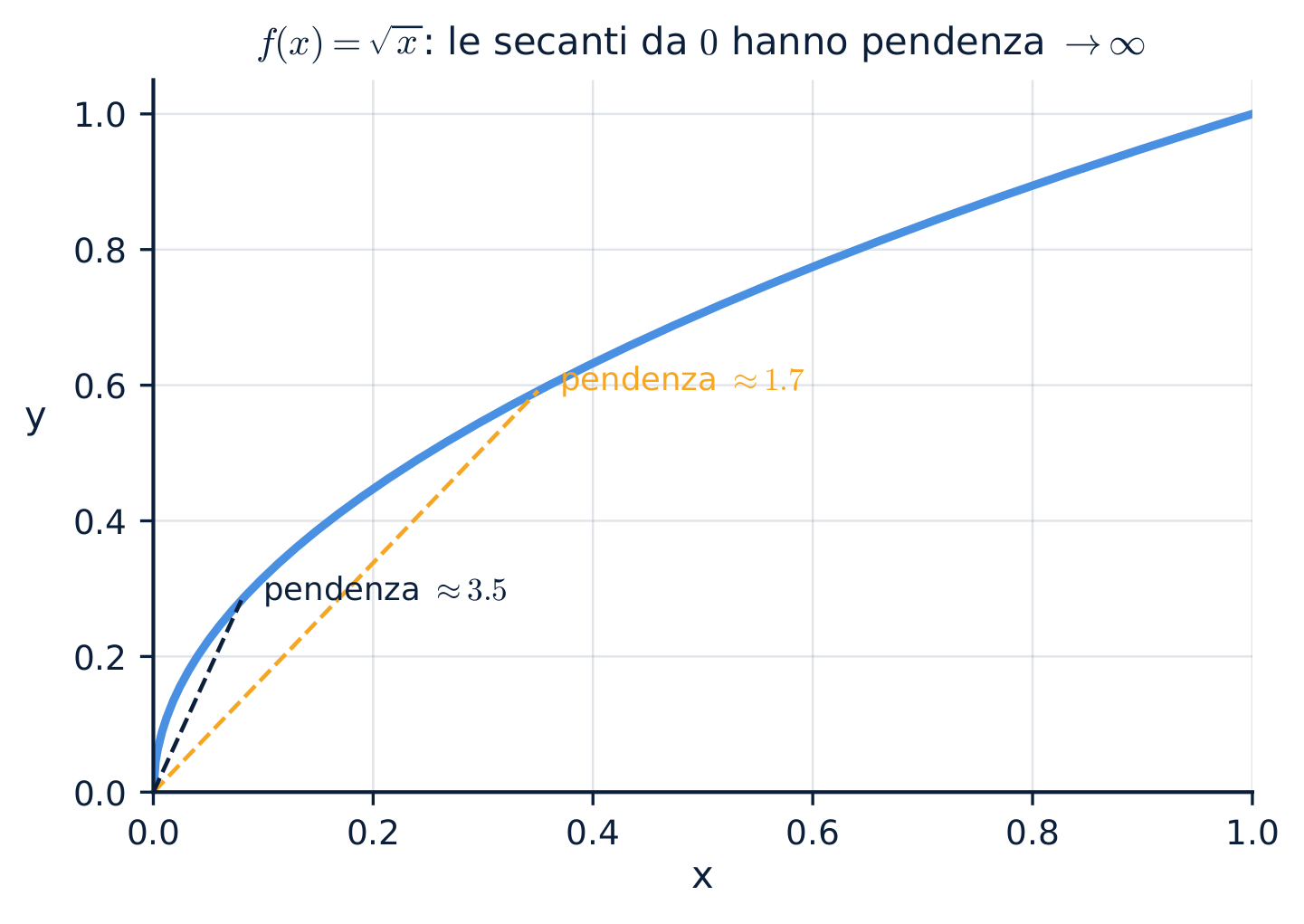
If f were Lipschitz continuous on [0,1], there would exist L such that |√x−√0| ≤ L|x−0| for every x,y ∈ [0,1]; in particular, taking y=0 and restricting to x ∈ (0,1], we would have √x ≤ Lx, i.e. 1/√x ≤ L for every x ∈ (0,1]. But 1/√x → +∞ as x→0⁺, so no finite L can satisfy the inequality for every x: contradiction. The geometric phenomenon is that the slope of the graph of √x at 0 is infinite (vertical tangent line).
Delicate case 3.1 (Local vs. global Lipschitz continuity)
A common source of confusion is the distinction between local Lipschitz continuity (on every bounded subinterval) and global Lipschitz continuity (on the whole domain). For example f(x)=x² is Lipschitz continuous on every bounded interval [a,b] (by Corollary 3.1, with L = sup[a,b]|2x| = 2max(|a|,|b|)), but is not Lipschitz continuous on all of ℝ: if it were with constant L, taking x=L+1, y=0 we would have |f(x)−f(y)| = (L+1)² > L(L+1) = L|x−y|, a contradiction. The Lipschitz constant, when it exists, in general depends on the width of the interval considered.