4. Hölder Continuity
Definition 4.1 (Hölder-continuous function)
Let α ∈ (0,1]. f: I → ℝ is Hölder continuous of exponent α (written f ∈ C0,α(I)) if there exists C ≥ 0 such that:
Proposition 4.1 (Hölder continuity ⇒ uniform continuity)
If f: I → ℝ is Hölder continuous of exponent α and constant C (on any interval I, even unbounded), then f is uniformly continuous on I.
Proof. If C=0, f is constant and the claim is trivial. If C>0, given ε>0 it suffices to choose δ=(ε/C)1/α: then |x−y|<δ ⇒ |f(x)−f(y)| ≤ C|x−y|α < Cδα = ε. Note that, unlike Theorem 4.1 below, no boundedness hypothesis on I is needed here: the estimate is direct.
∎
Observation 4.2
For α=1 we recover exactly the definition of Lipschitz continuity: C0,1(I) is the set of Lipschitz-continuous functions on I. By Proposition 4.1, every Hölder-continuous function (for any α) is already uniformly continuous: the exponent α therefore measures an intermediate degree of regularity between uniform continuity and Lipschitz continuity — the closer α is to 1, the more stringent the condition.
Theorem 4.1 (Hierarchy of Hölder classes on bounded domains)
Let I be a bounded interval (of diameter D := supx,y∈I|x−y| < ∞) and let 0 < α₁ ≤ α₂ ≤ 1. Then:
Proof. Let f ∈ C0,α₂(I), with |f(x)−f(y)| ≤ C|x−y|α₂ for every x,y ∈ I. For x,y ∈ I with x≠y write, using |x−y| ≤ D and α₂−α₁ ≥ 0:where the last inequality follows from the fact that t ↦ tα₂−α₁ is increasing on [0,+∞) and |x−y| ≤ D. Hence:i.e. f ∈ C0,α₁(I).
∎
Observation 4.3
The hypothesis that I be bounded is essential: on an unbounded domain the inequality |x−y|α₂−α₁ ≤ Dα₂−α₁ makes no sense (D=∞), and indeed the inclusion can fail on ℝ.
Example 4.1 (f(x)=√x is 1/2-Hölder continuous but not Lipschitz continuous)
On [0,1], f(x) = √x satisfies:
so f ∈ C0,1/2([0,1]) (the inequality, valid more generally for every x,y≥0, was already proved in Example 2.1, where it was needed for the uniform continuity of √x). By Counterexample 3.1, √x is not Lipschitz continuous on [0,1]: it is a genuine example of a function that is Hölder continuous but not Lipschitz continuous, sitting exactly midway in the hierarchy (the same vertical tangent at 0 that prevents Lipschitz continuity is compatible with exponent 1/2).
Counterexample 4.1 (A uniformly continuous function that is not Hölder continuous for any exponent)
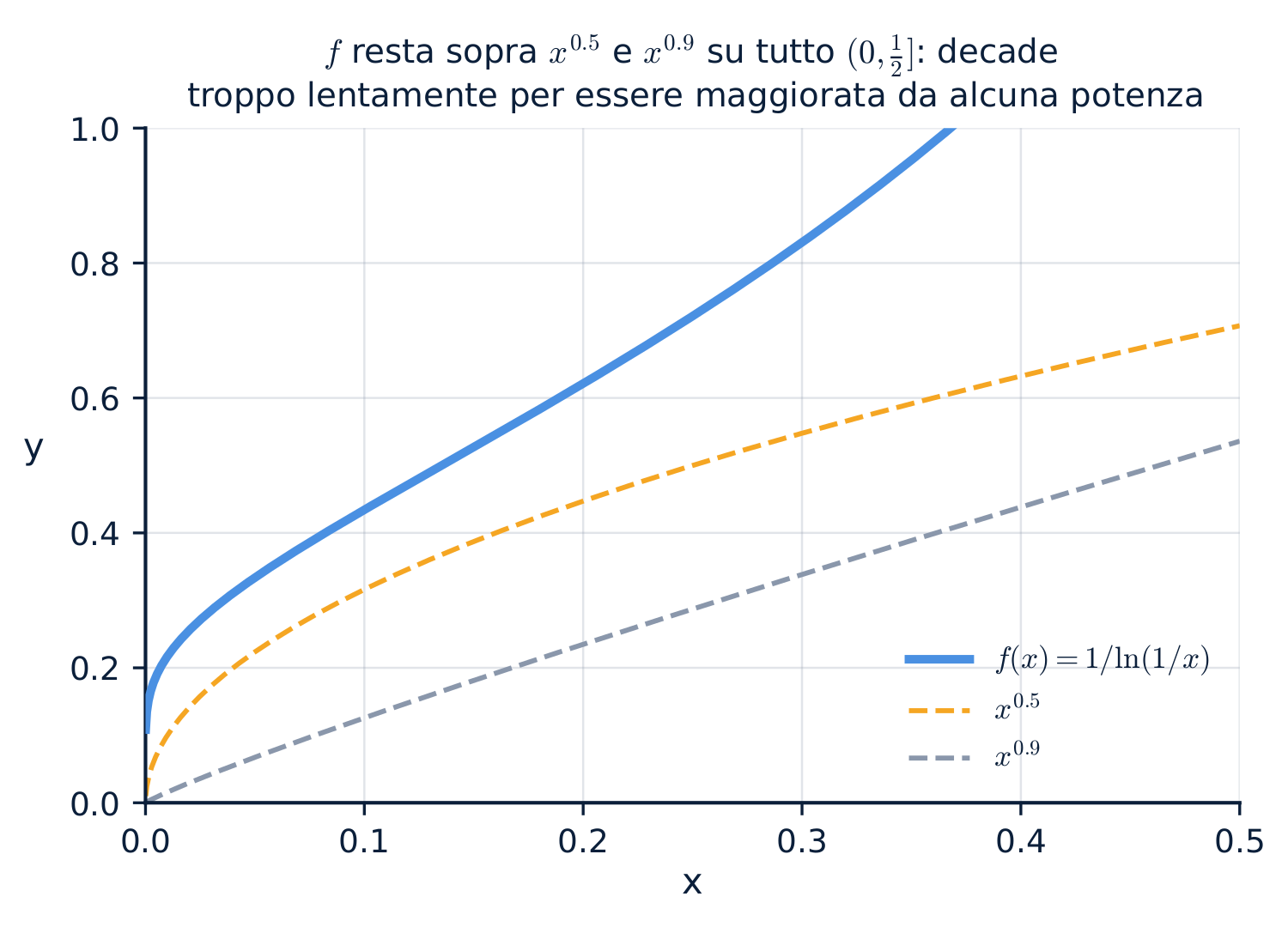
Define f: [0, 1/2] → ℝ as:
f is continuous on [0,1/2]: it is continuous on (0,1/2] (composition of continuous functions, with ln(1/x)≠0 for x≤1/2), and limx→0⁺ 1/ln(1/x) = 0 = f(0) since ln(1/x)→+∞. Since [0,1/2] is compact, by the Heine–Cantor theorem f is automatically uniformly continuous.
f is not Hölder continuous for any α ∈ (0,1]: if it were, with exponent α and constant C, taking y=0 we would have, for every x ∈ (0,1/2]:
But with the substitution t = ln(1/x) → +∞ (i.e. x=e-t):
because the exponential e-αt (with α>0) decays faster than t grows. Hence xα ln(1/x) → 0 as x→0⁺, which contradicts xα ln(1/x) ≥ 1/C > 0 for every x. No constant C can work, for any α ∈ (0,1]: f does not belong to C0,α([0,1/2]) for any α.
This counterexample shows that the inclusion C0,α(I) ⫋ C(I) is always strict, even on compact domains where uniform continuity and continuity coincide: there exist uniformly continuous functions "at the limit," with a logarithmic modulus of continuity (ω(t) ~ 1/ln(1/t)) too weak to fall into any Hölder class.
The Cantor function, which we take up in full detail in Delicate case 5.1 of the next section, is already a first example of a Hölder-continuous function that behaves surprisingly with respect to absolute continuity.