5. Your turn
The problems below need only the tools in these pages. Solutions are at the end.
Problem 1. Check that the cycle of the variant (Example 3.6) really is a cycle, and show that with the same rule the number enters the cycle .
Problem 2. Prove that numbers of the form drop below their starting value in 3 steps of the map . (Hint: they are a special case of a proposition we have already seen.)
Problem 3. Consider the numbers of the form , with an integer.
- Compute the first 7 steps of the map in terms of and check that you reach a value still greater than .
- The next step depends on the parity of . For which values of can you conclude that the orbit of drops below , and after how many steps?
- What happens in the other cases? Compare the result with Subtle case 2.5.
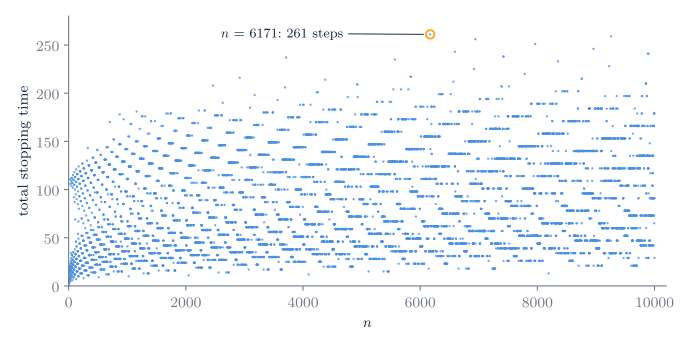
Problem 4. Compute the total stopping time of a number of your choice between and , by hand or with the program below.
A few lines of Python are enough to explore with a computer:
def collatz(n):
    orbit = [n]
    while n != 1:
        n = n // 2 if n % 2 == 0 else 3 * n + 1
        orbit.append(n)
    return orbit

o = collatz(27)
print("steps:", len(o) - 1, "  maximum:", max(o))
The program prints steps: 111 maximum: 9232. A challenge: modify it to find the number below with the longest total stopping time.
Solutions
Problem 1. is odd: ; then ; ; then and . For : , then .
Problem 2. is of the form with : Proposition 2.2 is enough.
Problem 3.
- The first 7 steps are and for every .
- If is even, , that is : then is even and the next step gives , which is smaller than . The orbit drops below after 8 steps.
- If is odd, , that is : then is odd, the next two steps give and then , still greater than , and the parity at the following step depends on . At this level the case remains open: the class modulo is indeed one of the four open classes modulo in the table of Subtle case 2.5. So the numbers split into two halves: for one the descent is proved, for the other we would need to split further, with no guarantee of settling the case.
Problem 4. For checking: steps, , , , , , , , , , .