Introduction. A children's puzzle, unsolved for almost a century
Think of a positive whole number, any one at all. Now follow two rules:
- if the number is even, halve it;
- if it is odd, triple it and add 1.
Take the result and start again, and keep going.
Let's start from 6. It is even, so it becomes 3. 3 is odd: tripled it makes 9, plus 1 makes 10. Then 5, then 16, then 8, 4, 2 and finally 1. Once you reach 1, the rules go round in a circle: 1 becomes 4, then 2, then 1 again. That is the end of the line, and that is where we stop.
With 7 the road is longer: it goes through 22, 11, 34, 17, 52, 26, 13, 40, 20, 10, 5, 16, 8, 4, 2, and only then reaches 1, after 16 steps.
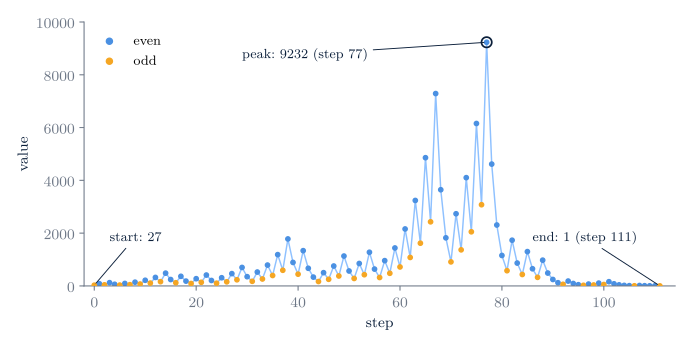
27 has a surprise in store. It looks like a quiet number, yet its sequence climbs for dozens of steps, falls, climbs again, and reaches a peak of 9232, more than three hundred times its starting point. Then it collapses, and reaches 1 after 111 steps. Its neighbour 28, on the other hand, gets there in 18.
Try it yourself
Everything runs in your browser, with arbitrary-precision integers (BigInt): no data is sent anywhere.
Try any number you like: sooner or later you will reach 1. Every number anyone has ever tried has got there. The question is very simple:
The question
Starting from any positive whole number, do you always reach 1?
Nobody knows the answer. This is the Collatz conjecture: a conjecture is a statement believed to be true that nobody has yet managed to prove.
A problem with many names
Its origins are not entirely clear, because for decades the problem travelled by word of mouth rather than in journals. It is traditionally attributed to Lothar Collatz, a German mathematician at the University of Hamburg: in the 1930s, as a student, he studied functions of this kind, and one of his notebooks, dated 1 July 1932, contains a closely related one. Collatz never published these problems, but he discussed them with colleagues at the 1950 International Congress of Mathematicians in Cambridge, Massachusetts. Another mathematician, Bryan Thwaites, claimed to have discovered it independently in 1952.
From there the problem travelled from university to university, picking up a new name each time. Helmut Hasse, a colleague of Collatz, talked about it with many people and proposed the name Syracuse problem during a visit to Syracuse University, in New York State. Around 1960 Shizuo Kakutani circulated it at Yale: he said that for about a month everybody there worked on it with no result, and that at Chicago people joked that the problem was part of a conspiracy to slow down mathematical research in the United States. Stanisław Ulam, the Manhattan Project mathematician, spread it at Los Alamos. So today it goes by the Collatz problem, the Syracuse problem, Kakutani's problem, Ulam's problem, or simply the problem.
Several mathematicians have offered money for a solution: 50 dollars from Harold Coxeter in 1970, 500 dollars from Paul Erdős. Erdős, one of the most prolific mathematicians of the twentieth century, is reported to have said: "Mathematics is not yet ready for such problems" [Lagarias 1985].
What we know today
Computers have checked the conjecture on enormous numbers. In 2025 David Bařina, of Brno University of Technology, published a verification for all numbers up to , that is, more than two sextillion, spreading the calculation over thousands of processors on European supercomputers [Bařina 2025]. Not a single exception. But the whole numbers are infinite, and no computer can try them all.
On the proof side, the biggest step forward came in September 2019. Terence Tao, one of the best-known mathematicians in the world, proved that the conjecture is true "almost always", in a precise sense: almost all numbers sooner or later fall to values that are tiny compared with where they started [Tao 2022]. The result attracted attention beyond specialist circles, and experts welcomed it as the best in a very long time [Hartnett 2019]. But "almost all" is not "all": somewhere among the numbers there might still be one that escapes the rule.
The same article reports that young researchers are often advised to stay away from it: it is a problem that can turn into an obsession and cost years with nothing to show for them [Hartnett 2019].
Why should we care?
The Collatz conjecture will not help build bridges or make phones work. Yet it is a serious question. It combines two elementary operations, multiplying by 3 and dividing by 2, and shows how little we can predict about what happens when they alternate. If such a simple problem has resisted for almost a century, some idea is still missing, and the ideas born to solve problems like this often end up being useful elsewhere.
The pages that follow go into the details, with difficulty that grows a little at a time. Next to each section title, one to three filled dots show its level: For everyone, High school and up (for readers comfortable with the mathematics of the last two years of high school) and University (proofs in the language of university courses). You can stop wherever you like.