1. Review: resistive networks and the network truncated at n stages
Review (series/parallel combination). Two resistors R₁,R₂ in series give total resistance R₁+R₂; in parallel they give R₁∥R₂ = R₁R₂/(R₁+R₂).
Definition 1.1 (Network truncated at n stages)
We call the network truncated at n stages the finite network obtained by keeping only the first n "L" cells starting from terminals A-B, and terminating beyond the last cell with an open circuit (that is: the last shunt resistor Rp is the final element of the network, nothing follows it). We denote by Rn the resistance seen at terminals A-B of this finite network.
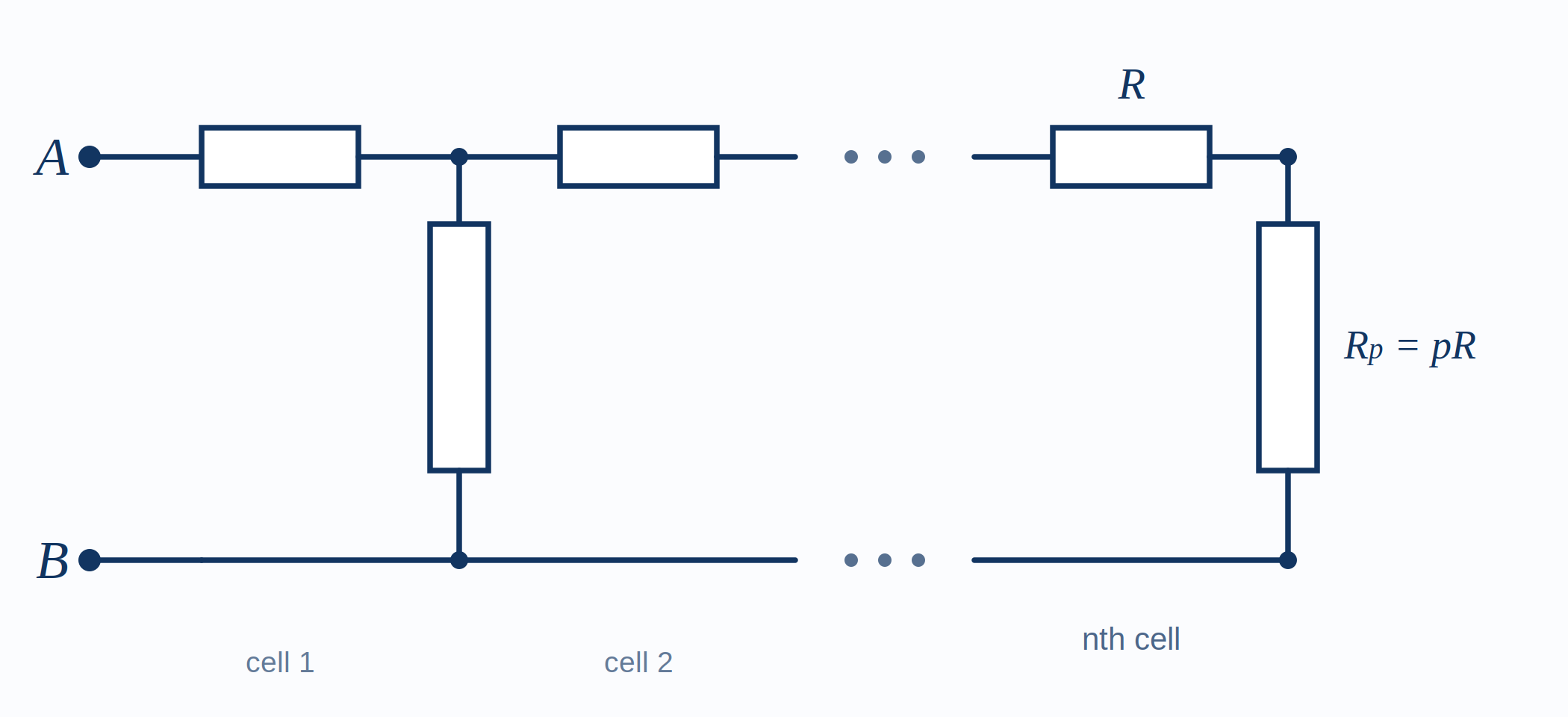
For n=1 (a single cell, no network beyond it), the parallel combination is with an open circuit, so the resistor Rp is simply the last series element:
For n≥2, the first cell sees, in place of the plain Rp, the combination of Rp in parallel with the entire remaining subnetwork (which is itself a network truncated at n-1 stages, of resistance Rn-1):
Recursive relation:
This relation is the starting point both for Method 1 (Sections 2–3, where we study the behaviour of (Rn) as n→∞) and for Method 2 (Section 5, where for p=1 we recognize in (Rn) the sequence of Fibonacci ratios).
It is convenient to work in dimensionless form: set rk := Rk/R for every k∈{1,…,n} (in particular, rk is a pure, dimensionless number). We divide both sides of the recursive relation by R, and substitute Rp=pR and Rn-1= rn-1R:
Likewise, from the base case R1=R(1+p) we get r1=1+p. The recursive relation thus becomes