2. Existence and uniqueness of R_eq
This section provides a rigorous foundation for what Method 1 (Section 3) does in a purely formal way.
Definition 2.1
Let (with p>0 fixed)
The recursive relation from Section 1 can then be written as rn = f(rn-1).
Observation
f is well defined and positive-valued: for x>0 we have p+x>0 and f(x)>1>0.
Lemma 2.1 (monotonicity of f)
f is strictly increasing on (0,∞).
Proof. f'(x) = [p(p+x)−px]/(p+x)² = p²/(p+x)² > 0 for every x>0.
∎
Observation (a common pitfall)
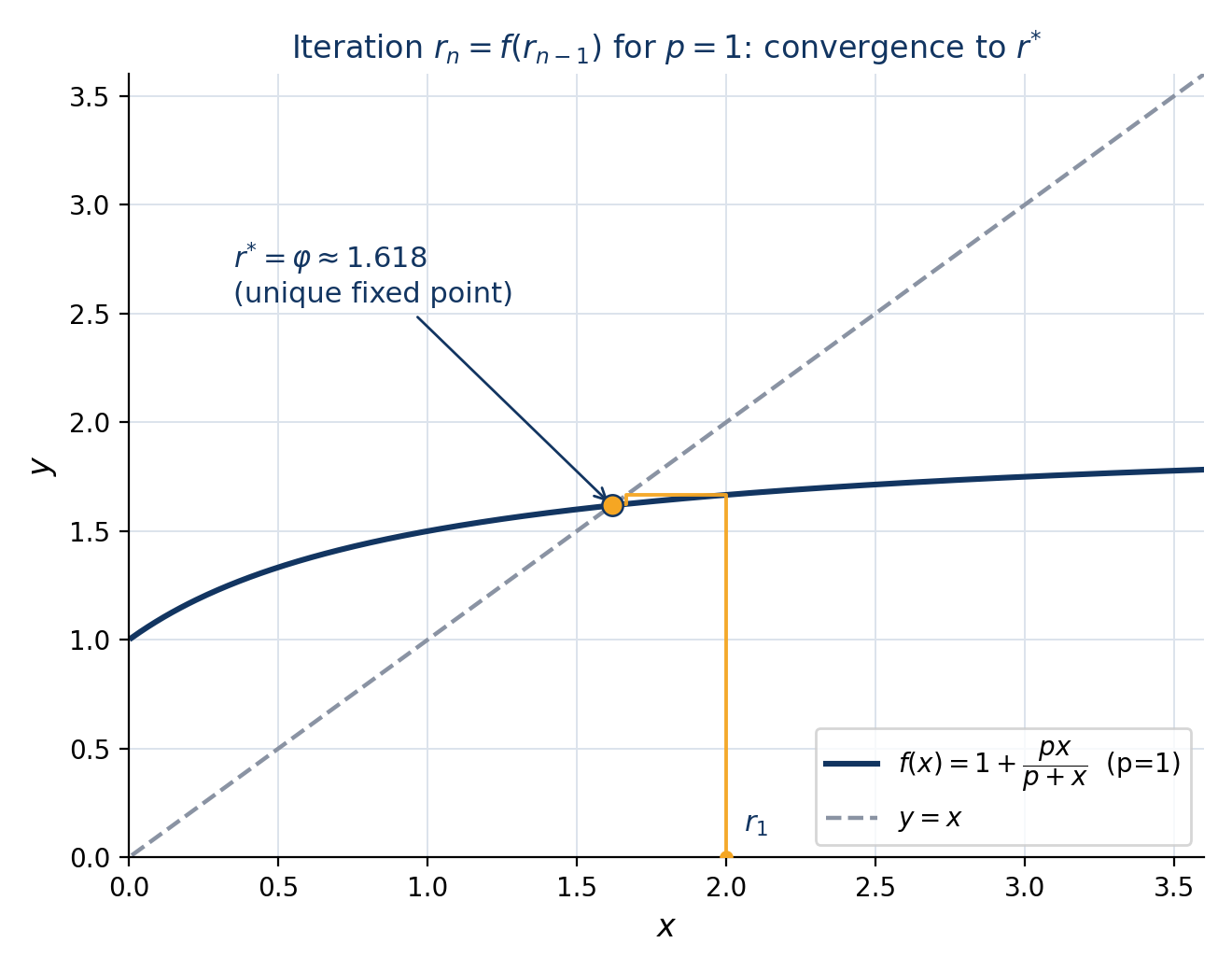
Knowing that f is increasing does not yet tell us whether the sequence (rn), defined by rn=f(rn-1), is itself increasing or decreasing: the monotonicity of f and the monotonicity of the sequence it generates are two distinct things. What governs the direction of the iteration is the sign of the auxiliary function g(x):=f(x)−x: if g(x)<0 one step of the iteration makes the value decrease (f(x)<x); if g(x)>0 it makes it increase. Let us study g.
Lemma 2.2 (fixed point)
Let g(x):=f(x)−x. Then g is strictly decreasing on (0,∞), and the equation f(x)=x has, among positive solutions, a unique solution
Moreover g(x)<0 for x>r* and g(x)>0 for 0<x<r*.
Proof. First, g'(x)=f'(x)−1 = p²/(p+x)²−1 <0 for every x>0 (since p+x>p, so (p+x)²>p²): g is therefore strictly decreasing on (0,∞), and in particular injective, so it has at most one zero.
Let us now look for the zeros of g, i.e. the solutions of f(x)=x: 1+px/(p+x)=x ⟺ (p+x)+px = x(p+x) ⟺ x²−x−p=0 (algebraic details in Section 3). The two roots are (1±√(1+4p))/2. Since p>0, we have √(1+4p)>1, so the root (1−√(1+4p))/2 is negative and must be discarded: the only zero of g in the domain (0,∞) is r*=(1+√(1+4p))/2.
Since g is strictly decreasing with g(r*)=0, it follows immediately that g(x)<0 for x>r* and g(x)>0 for x<r*.
∎
Lemma 2.3
r₁ > r*, and rn>r* for every n≥1.
Proof. r₁=1+p; let us compare it with r*: since (1+2p)² = 1+4p+4p² > 1+4p for p>0, we have 1+2p>√(1+4p), hence r*=(1+√(1+4p))/2 < (1+(1+2p))/2=1+p=r₁. So r₁>r*.
By induction: if rn-1>r*, then by the monotonicity of f (Lemma 2.1 — this is where it is really needed) and since f(r*)=r* (Lemma 2.2), we get rn= f(rn-1)>f(r*)=r*.
∎
Theorem 2.4 (existence and uniqueness of R_eq)
The sequence (rn) is strictly decreasing and converges to r*=(1+√(1+4p))/2. Consequently Req=limn→∞Rn = R·r* = R/2·(1+√(1+4p)) exists, is unique, and is the only physically admissible value (the other root of the quadratic is negative, incompatible with a resistance).
Proof. By Lemma 2.3, rn>r* for every n; by Lemma 2.2, g(x)<0 for every x>r*; combining the two facts, g(rn)<0 for every n, i.e. rn+1=f(rn) <rn for every n: this is exactly the direction of the iteration hinted at in the remark after Lemma 2.1 — here we obtain its rigorous confirmation. The sequence (rn) is therefore strictly decreasing, and by Lemma 2.3 it is also bounded below by r*. By the monotone convergence theorem, it converges to some limit L≥r*. Taking the limit in the relation rn+1=f(rn), and by continuity of f, we obtain L=f(L): L is a positive fixed point of f, and by the uniqueness established in Lemma 2.2, L=r*.
∎