The problem of determining the equivalent resistance Req of an infinite ladder network is a classic example of circuit analysis, with applications in transmission lines and the modelling of composite materials.
Consider a network built from an infinite repetition of "L" cells, each consisting of:
- a series resistor of value R;
- a shunt (parallel) resistor, connected to the return rail, of value Rp = pR, where p is a positive real coefficient (p>0).
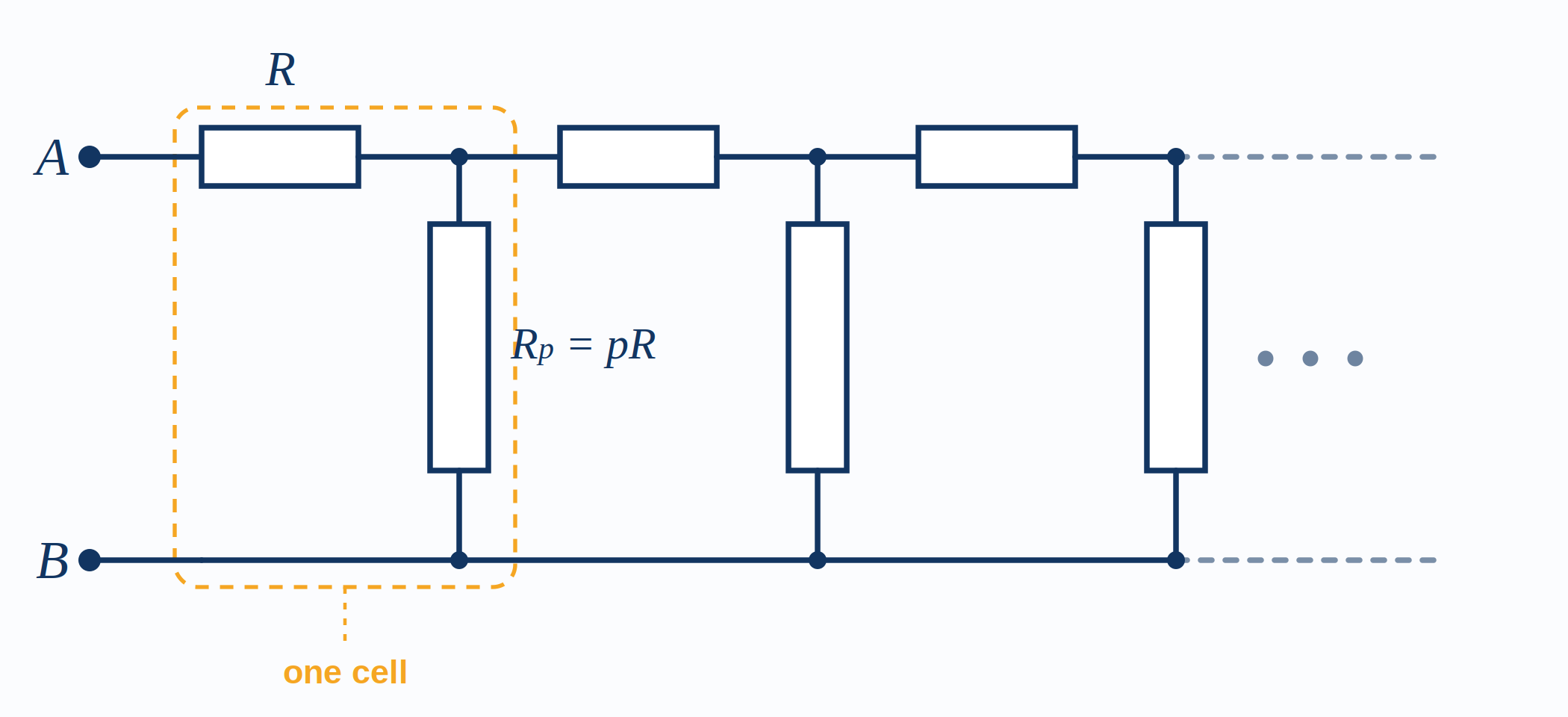
The goal is to compute the resistance seen at the input terminals A-B.
We will follow two paths, independent of each other but converging to the same result:
- Method 1 (Sections 2–3) – Self-consistency: exploiting the fact that the network is infinite, we show that Req must satisfy a fixed-point equation, whose only physically admissible solution is Req = R/2·(1+√(1+4p)).
- Method 2 (Section 5) – Continued fractions and Fibonacci: in the particular case p=1, we show that the resistance of the network truncated at n stages is the ratio of two consecutive Fibonacci numbers, and that the limit as n→∞ coincides with the Golden Ratio.
The case p=1 (Section 4) is the historically best-known one: the constant that emerges is the Golden Ratio φ≈1.618, an unexpected bridge between circuit theory and number theory. Section 6 explores what happens for arbitrary p, and a final appendix looks more closely at the connection with the family of "metallic numbers".
Scope. We deal exclusively with the real resistive case (DC regime). The extension to complex impedances (AC regime) is material for a separate article.